# Cochrane in numbers. The reference library of evidence
> How many reviews Cochrane has, what it is and why it is the benchmark for evidence. The real numbers of the Cochrane Library, not inflated and with sources.
Published at https://revisia.es/en/blog/cochrane-in-numbers/ · Author: Ángel González de la Flor · Date: 2026-09-10
If you have read anything about systematic reviews, you have heard of Cochrane. It is the reference, the gold standard against which the rest are measured. But try to put numbers on Cochrane and you run into contradictory figures, almost always inflated ones. This post explains what Cochrane is and how many reviews it really has, with the sources on the table.
## What Cochrane is
Cochrane is an independent, international, not-for-profit organization that produces systematic reviews of healthcare interventions with the highest methodological rigor. It was founded in 1993 and today brings together tens of thousands of contributors around the world. Its flagship product is the **Cochrane Database of Systematic Reviews** (CDSR), where its reviews are published, and its methods handbook sets many of the standards the rest of the field follows. If you need a refresher on the format itself, start with [what a systematic review is](/en/blog/what-is-a-systematic-review/).
What sets a Cochrane review apart is how demanding it is. It requires a protocol registered in advance, independent duplicate [screening](/en/blog/rayyan-vs-covidence/) and [data extraction](/en/blog/data-extraction-systematic-review/), a systematic [risk of bias assessment](/en/blog/risk-of-bias-assessment/) and a rating of the certainty of the evidence with GRADE (a scale for grading how much confidence the results deserve). It is a high bar, and that is why its reviews are treated as the reference.
## How many records it has (and why they are not all reviews)
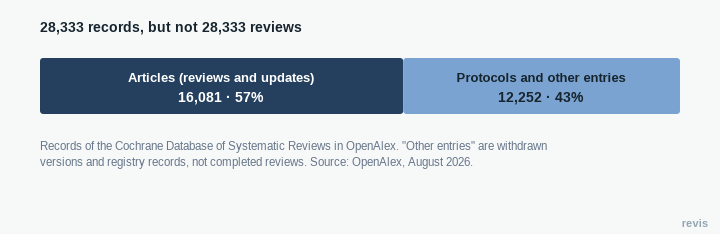
The most common confusion starts in bibliographic databases such as [OpenAlex](https://openalex.org/), where the CDSR shows up with **28,333 records**. It is tempting to read that as "28,333 systematic reviews", but that is a mistake. Broken down by type, only **16,081 are articles** (the reviews and their updated versions), while **12,252 are protocols, withdrawn versions and other registry entries**. In other words, more than 40% of what gets counted is not a finished review.
This is not a flaw in Cochrane, but in how its records are counted. Every Cochrane review starts as a published protocol, which has its own record, and many reviews are withdrawn or superseded, leaving a record behind as well. Counting everything together inflates the figure.
## How many reviews it really has
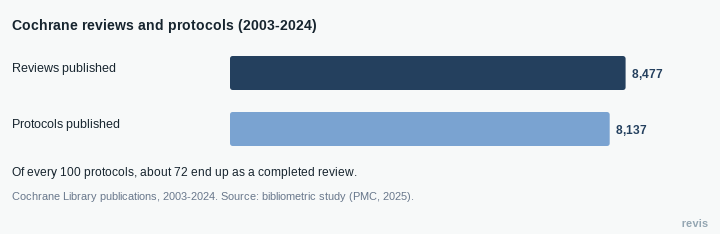
A [bibliometric study published in 2025](https://pmc.ncbi.nlm.nih.gov/articles/PMC12362767/) put clean numbers on the life cycle of Cochrane reviews. Between 2003 and 2024, Cochrane published **8,477 systematic reviews** and **8,137 protocols**. Of those protocols, **71.9% became a completed review**; the rest are still in progress or were withdrawn. Adding the reviews published before 2003 (for which there is no clean public count), the all-time total of Cochrane reviews is estimated at around nine or ten thousand, a long way from the 28,333 records of the inflated figure.
To put that in the context of this series, those ~8,500 reviews are a tiny fraction of the [more than 700,000 recorded in OpenAlex](/en/blog/how-many-systematic-reviews-are-published/). Cochrane has never competed on volume. Its bet is rigor: a few very demanding reviews rather than the flood of [too many systematic reviews](/en/blog/too-many-systematic-reviews/) of uneven quality.
## The weak spot is updating
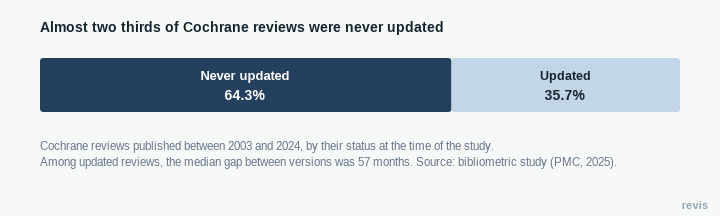
The same study points to a weakness in the model. A systematic review should be updated when new evidence appears, but **64.3% of Cochrane reviews had not been updated** at the time of the analysis, and among those that had, the median gap between versions was almost five years (57 months). Keeping thousands of demanding reviews current, mostly through volunteer work, is a huge challenge. That is the price of rigor. Doing it properly costs so much that redoing it often is not feasible. And a review that is never updated runs the risk of resting on [studies that are later retracted](/en/blog/retracted-systematic-reviews/).
Updating a review means screening the new evidence all over again. In revisia AI does that first pass and you verify each decision with the quote in front of you, following the method Cochrane made popular. Create your free account.
## Why it is still the gold standard
None of these figures diminishes Cochrane's role. Its value does not lie in volume, but in having defined how a rigorous systematic review is done and in having kept to it for three decades. Its handbook, its risk of bias tools and its insistence on duplicate review are now the standard that almost everyone follows, more or less faithfully. When a Cochrane review exists on your question, it is the first place to look.
If you are preparing your own review, it pays to know its methods even if you never publish with Cochrane. The [PRISMA flow diagram](/en/blog/prisma-flow-diagram/), [risk of bias assessment](/en/blog/risk-of-bias-assessment/) and a [well-documented search strategy](/en/blog/literature-search-strategy/) all come, to a large extent, from the tradition Cochrane consolidated.
Want to work with the method Cochrane made standard? In revisia you screen with AI and verify with the quote alongside, from start to finish. Create your free account and try it.
## Frequently asked questions
### How many reviews does Cochrane have?
Fewer than the figure that usually circulates suggests. In databases such as OpenAlex, the Cochrane Database shows 28,333 records, but only about 16,081 are review articles; the rest are protocols and other entries. According to a 2025 study, Cochrane published 8,477 systematic reviews between 2003 and 2024, and the all-time total is somewhere around nine or ten thousand.
### What is the Cochrane Database of Systematic Reviews?
It is the database where Cochrane publishes its systematic reviews of healthcare interventions. It is part of the Cochrane Library and is regarded as a reference source of high-quality evidence, because every review follows a very demanding method (a protocol written in advance, duplicate screening and extraction, risk of bias and GRADE).
### Why is Cochrane considered the gold standard?
Because it defined, and still maintains, the strictest methodological standards for systematic reviews: a protocol registered in advance, independent duplicate review at every stage, systematic risk of bias assessment and grading of the certainty of the evidence. Its methods handbook is a reference for the whole field, in medicine and beyond.
### Are all Cochrane reviews up to date?
No. According to a 2025 study, 64.3% of Cochrane reviews had not been updated at the time of the analysis, and among those that had, the median gap between versions was about 57 months. Keeping thousands of demanding reviews current, largely with volunteer work, is one of the biggest challenges of the model.