# The best databases for systematic reviews

> Databases for systematic reviews compared: PubMed, Scopus, Web of Science, Cochrane, CINAHL, Embase, SciELO and Dialnet. Which to use and how to search each.

Published at https://revisia.es/en/blog/databases-for-systematic-reviews/ · Author: Ángel González de la Flor · Date: 2026-10-12

A systematic review is a synthesis of evidence that follows an explicit, reproducible method. Its search cannot depend on a single source. The main methods guidance (PRISMA and the Cochrane Handbook) recommends searching several **databases for systematic reviews**, usually at least three to five, to reduce study selection bias. In practice the core almost always includes PubMed/MEDLINE, Scopus or Web of Science and, in the health sciences, the Cochrane Library, supplemented with regional and non-English databases (Dialnet, SciELO, LILACS) and subject-specific sources. Each section below explains what the database is, what it covers, how you get access and how to search it.

## How many databases for a systematic review, and which ones (PRISMA/Cochrane guidance)

Before discussing which database is best, decide how many you need and which ones. No database indexes all the literature. Each has its own subject focus, journal selection policy and geographic coverage. If you search only one, you will miss relevant studies and your review will lose rigor.

The recommendations in the methods guidance can be summarized like this:

- PRISMA 2020 requires you to report every source you searched (databases, registers and other methods) with the date of the last search, so anyone can reproduce it. It doesn't set an exact number, but it assumes you search several, and those counts are the first thing the [PRISMA flow diagram](/tools/en/prisma-flow-diagram/) asks for.
- For reviews of health interventions, the Cochrane Handbook recommends searching at least MEDLINE (through PubMed or another platform), Embase and the Cochrane Central Register of Controlled Trials (CENTRAL). From there you add subject or regional databases depending on the question.
- For reviews outside clinical topics (education, psychology, social sciences), the usual approach is to combine a multidisciplinary database (Scopus or Web of Science) with specialized databases (PsycINFO, ERIC) and sources in the language of the region you are studying.

As a rule of thumb, search at least three complementary databases (one multidisciplinary, one specific to your field and one regional or in your language), document the full strategy for each, and record the date and number of results. Before you start searching, work out your [literature search strategy with Boolean operators and MeSH terms](/en/blog/literature-search-strategy/), because each database requires you to adapt the string to its own syntax.

## PubMed / MEDLINE (what it is, non-English literature, how to search)

### What PubMed is

PubMed is the free search engine of the US National Library of Medicine (NLM). Its core is MEDLINE, the reference bibliographic database in biomedicine, but PubMed also includes records in the process of being indexed and content from PubMed Central. It is by far the most used source in health reviews. It is free, its biomedical coverage is very broad, and its MeSH controlled vocabulary allows very precise searches.

It helps to keep the terms apart:

- MEDLINE. The database (the records indexed with MeSH terms).
- PubMed. The free interface that gives access to MEDLINE and a bit more.
- MeSH (Medical Subject Headings). The thesaurus the NLM uses to tag each article by topic.

### Non-English literature in PubMed

PubMed has no full official interface in other languages. The platform and the MeSH headings are in English. You can still work with literature in other languages, such as Spanish, in several ways:

- It indexes many non-English journals, so many articles in those languages show up in the results (with their original abstract).
- To search for concepts that come to you in another language, translate your terms into English MeSH vocabulary (the descriptors structure the search) and, in parallel, use the DeCS equivalent (Health Sciences Descriptors), the trilingual version of MeSH in Spanish, Portuguese and English, which is very useful for searching LILACS or SciELO afterward.
- Your browser can translate the interface automatically, but this doesn't change the indexing. An effective search is still built with English MeSH terms.

### How to search PubMed

A reproducible PubMed search combines free text and controlled vocabulary:

1. Identify the key concepts in your question (ideally framed with the [PICO model](/en/blog/pico-question/)).
2. For each concept, find the matching MeSH term in the MeSH Database.
3. Combine the MeSH terms with free-text synonyms using Boolean operators (OR within each concept, AND between concepts).
4. Use filters with caution. Limiting by language or date can introduce bias, so justify it in the protocol.
5. Save the full strategy and the number of results for the [PRISMA flow diagram](/en/blog/prisma-flow-diagram/).

## Scopus (what it is, Scopus vs Web of Science)

### What Scopus is

Scopus is a multidisciplinary bibliographic and citation database from the publisher Elsevier. Unlike PubMed, it is not free. Access usually comes through your university's or library's institutional subscription. Its coverage spans every field (science, engineering, social sciences, arts and humanities), with thousands of peer-reviewed journals plus conference proceedings and books. Because of its size and its citation analysis, it is one of the preferred multidisciplinary databases outside purely biomedical topics.

### Scopus vs Web of Science

Scopus and Web of Science are the two big multidisciplinary citation databases. Which one to use is a very common question, but the methods guidance doesn't frame it as a choice. In a systematic review you should search both, because they only partly overlap and each indexes journals the other doesn't cover. Even so, it helps to know how they differ.

| Feature | Scopus | Web of Science |
|---|---|---|
| Publisher | Elsevier | Clarivate |
| Coverage | Very broad, multidisciplinary | Multidisciplinary, with a more selective core (Core Collection) |
| Historical focus | Broader on recent and regional journals | More selective, with deep citation history |
| Access | Institutional subscription | Institutional subscription |
| Typical use | Broad coverage and metrics | Core of high-impact journals and citation analysis |

In practice, if you have access to both, search both. If you only have one, state the limitation in your [review protocol](/en/blog/prospero-registration/) and back it up with other sources.

## Web of Science

Web of Science (WoS), from Clarivate, is the other big multidisciplinary citation database. Its best-known component is the Core Collection, a selective set of indexes (including the Science Citation Index and the Social Sciences Citation Index) that brings together high-impact journals in every field. As with Scopus, access is through an institutional subscription, with no general open access.

Its value for a systematic review is twofold:

- Multidisciplinary coverage that complements PubMed (which is biomedical) and Scopus.
- Citation analysis with deep historical reach, useful when you need to trace how a study has been cited over time or to run backward and forward citation tracking (snowballing) from the references.

As with Scopus, you have to adapt your search string to WoS syntax and document the search fields, filters, date and number of results.

## Cochrane Library (reviews and trials)

The Cochrane Library is a collection of databases focused on evidence for health decision-making. For a clinical systematic review it is close to mandatory. The reason lies in two of its components:

- The Cochrane Database of Systematic Reviews (CDSR), which holds Cochrane systematic reviews, known for their methodological quality. It is useful for checking whether a review on your question already exists and avoiding duplicated effort. Its reviews often include [meta-analyses](/en/blog/what-is-a-meta-analysis/) built with [RevMan, its free software](/en/blog/meta-analysis-software/).
- The Cochrane Central Register of Controlled Trials (CENTRAL), a very comprehensive register of controlled clinical trials gathered from many sources. This is why the Cochrane Handbook includes it among the minimum recommended searches.

As for access, part of the content is free, and in many countries national or institutional agreements provide full access. The interface is in English, although some plain language summaries are translated. For intervention reviews, searching CENTRAL helps you capture trials that are not always clearly indexed in MEDLINE or Embase.

<p class="blog-inline-cta">In revisia <strong>you search several sources at once and duplicates are removed automatically</strong> before you start screening. <a href="https://revisia.es/app/entrar?registro=1">Create your free account</a>.</p>

## Dialnet, the main Spanish-language database

Limiting the search to English-language databases introduces language bias and leaves out relevant Ibero-American literature. For reviews carried out in Spain or Latin America, or on topics from that region, you should add Spanish-language databases. The largest is Dialnet.

Dialnet is one of the largest Spanish-language bibliographic portals, run by the University of La Rioja. Its coverage is multidisciplinary, with a strong weight in the social sciences and humanities and also in the health sciences, and it includes journal articles, book chapters, theses and conference proceedings from the Spanish-speaking world. Access to the references is free (with more options if you register for Dialnet Plus), although full-text availability depends on each document. It is especially useful for undergraduate theses, master's dissertations and reviews in fields where much of the research is published in Spanish.

**How to search Dialnet.** Combine your key concepts in the document search box. Dialnet doesn't support PubMed's advanced Boolean syntax, so run several searches with synonyms and also browse the journals and tables of contents in your field. You can filter by document type (article, thesis, book), year and language, and browse by author or journal to find related literature.

**Limits for a systematic review.** Dialnet is the best way to avoid missing Spanish-language research, but its quality control is uneven and its search is less reproducible than that of an indexed database like PubMed or Scopus. Document your strategy carefully and don't use it as your only source. **Exporting.** Each record lets you download the citation (RIS) to bring it into your [reference manager](/en/blog/mendeley-vs-zotero/) and deduplicate it against the other databases.

## Other Spanish- and Portuguese-language databases: SciELO and LILACS

### SciELO

SciELO (Scientific Electronic Library Online) is an open-access electronic library that brings together quality scientific journals from Latin America, Spain, Portugal and other countries. Its coverage is multidisciplinary, and its big advantage is free full text. For a review, it adds peer-reviewed regional literature that is often missing from Scopus or Web of Science.

### LILACS

LILACS (Latin American and Caribbean Health Sciences Literature) is the reference database for health sciences in the region, coordinated by BIREME/PAHO/WHO. Access is free and you search it with DeCS descriptors (the Spanish and Portuguese counterpart of MeSH). It is the main regional source for biomedical reviews with an Ibero-American focus and complements PubMed very well.

## Subject databases: CINAHL, PsycINFO and Embase

General databases are not enough. Almost every review also needs a source specialized in its field, and these are the three most common.

### CINAHL (nursing)

CINAHL (Cumulative Index to Nursing and Allied Health Literature) is the reference database for nursing and allied health (physical therapy, occupational therapy, nutrition, and so on). It indexes journals that are not always in MEDLINE and uses its own subject headings. It requires a subscription, usually available through your university library. If your review is about care, skipping CINAHL leaves out important literature.

### PsycINFO (psychology)

PsycINFO, from the American Psychological Association, is the specialized database for psychology and the behavioral sciences. It covers clinical, educational and social psychology and related fields, and includes articles, book chapters and dissertations. Access is by subscription. For reviews in psychology or mental health it is the reference subject source, complementing PubMed and the multidisciplinary databases.

### Embase

Embase, from Elsevier, is a large biomedical database that complements MEDLINE. Its coverage is especially strong in pharmacology, medical devices and European literature, and its own controlled vocabulary (Emtree) is more detailed for drugs. It requires a subscription. The Cochrane Handbook considers it part of the minimum search for intervention reviews precisely because it captures studies (mainly European and pharmacological ones) that MEDLINE doesn't index.

Another source that shows up more and more in protocols is Epistemonikos, a free collaborative database focused on systematic reviews and secondary evidence, useful for finding existing reviews on your question.

## Comparison table (coverage, access, language)
![Comparison of databases for systematic reviews. Coverage, access and language](/blog-img/en/comparativa-bases-datos.svg)

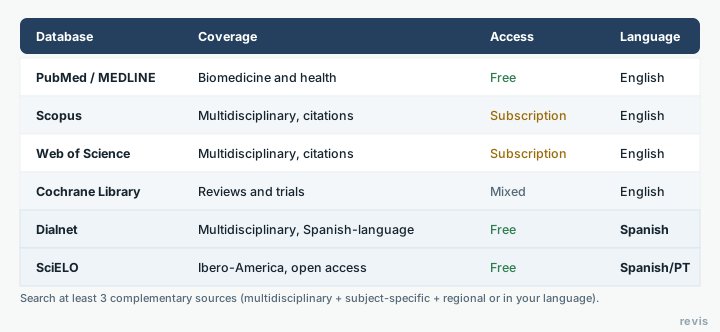
The table below summarizes the main databases for systematic reviews. Use it as a starting point for choosing your combination, not as a substitute for the methodological decision. What matters is that the sources you choose complement each other and cover your field and your region.

| Database | Coverage | Access | Language |
|---|---|---|---|
| PubMed / MEDLINE | Biomedicine and health sciences | Free | English interface (includes articles in several languages) |
| Scopus | Multidisciplinary, with citation analysis | Subscription | English |
| Web of Science | Multidisciplinary, selective citation core | Subscription | English |
| Cochrane Library | Systematic reviews and clinical trials (health) | Partly free, depending on country and institution | English (some summaries translated) |
| Dialnet | Multidisciplinary, Spanish-language focus (humanities and social sciences) | Free (references) | Spanish |
| SciELO | Multidisciplinary, Ibero-American open access | Free (full text) | Spanish, Portuguese and English |
| LILACS | Health sciences, Latin America and the Caribbean | Free | Spanish, Portuguese and English |
| CINAHL | Nursing and allied health | Subscription | English |
| PsycINFO | Psychology and behavioral sciences | Subscription | English |
| Embase | Biomedicine, strong in pharmacology and Europe | Subscription | English |

Once you have the references from all these sources, you need a system to manage them and remove duplicates. That is where choosing a [reference manager such as Mendeley or Zotero](/en/blog/mendeley-vs-zotero/) comes in: it centralizes all the results and helps you document the [screening of the articles](/en/blog/rayyan-vs-covidence/).

Remember that this guide is one piece of the whole process. Read the [main guide on what a systematic review is and how to do one step by step](/en/blog/what-is-a-systematic-review/) to place the database search within the stages of the method.

<p class="blog-inline-cta">Bring the results from several databases into one place. In revisia <strong>you import, deduplicate and screen</strong> without switching tools. <a href="https://revisia.es/app/entrar?registro=1">Create your free account</a>.</p>

## Frequently asked questions

### Is PubMed the same as MEDLINE?

Not exactly. PubMed is the free interface that gives access to MEDLINE and to other additional records of biomedical literature.

### What is the Cochrane Library?

A collection of evidence-focused databases that includes Cochrane systematic reviews and a register of clinical trials.

### Can I do a review with Google Scholar alone?

It is not recommended as your only source. Its coverage is neither transparent nor reproducible, although it can work as a supplement.

### What is PubMed?

PubMed is the free search engine of the US National Library of Medicine that gives access to MEDLINE, the reference bibliographic database in biomedicine. Its MeSH controlled vocabulary allows precise searches, and it is the most used source in health reviews because it is free and has very broad coverage.

### Scopus or Web of Science?

In a systematic review you should use both rather than pick one, because they index different journals and only partly overlap. If you have access to both (both need an institutional subscription), search both. If you only have one, state it as a limitation in the protocol and strengthen the search with other databases.

### What is Dialnet?

Dialnet is a large Spanish-language bibliographic portal run by the University of La Rioja, with multidisciplinary coverage and a strong presence in the humanities and social sciences. Access to the references is free, and it is especially useful for reviews, theses and dissertations in fields where much of the research is published in Spanish.

### How many databases should you search in a systematic review?

There is no fixed number, but methods guidance recommends searching several complementary sources, usually at least three. For reviews of health interventions, the Cochrane Handbook suggests searching at least MEDLINE, Embase and CENTRAL, and adding subject or regional databases depending on the question. The key is to combine a multidisciplinary database, one specific to your field and one regional or in your language, and to document the strategy for each one.

