# How many studies does a systematic review need? There is no minimum
> There is no minimum number of studies for a systematic review. The typical Cochrane review includes 6 trials and 8.7% include none. What sets the number.
Published at https://revisia.es/en/blog/how-many-studies-in-a-systematic-review/ · Author: Ángel González de la Flor · Date: 2026-10-12
How many studies does a systematic review need? There is no minimum number, and you should be wary of anyone who gives you one. The validity of a [systematic review](/en/blog/what-is-a-systematic-review/) doesn't depend on how many studies end up included. It depends on the search being comprehensive and on the selection criteria being defined before you start looking at results. The final number is a result of the method, not a decision you make. That said, there are published figures that serve as a benchmark. The typical Cochrane review includes six trials, there are legitimate reviews with zero included studies, and some searches return thousands of records only to end with a dozen. This guide goes through those figures, explains the funnel they come from, and gives a concrete plan for the two usual scares: coming up short and drowning in results.
## Where the number comes from (and why there is no minimum number of studies)
The number of articles in a systematic review is decided in three places, and none of them is up for negotiation at the end. The [research question](/en/blog/pico-question/) marks out the ground. The [inclusion and exclusion criteria](/en/blog/inclusion-and-exclusion-criteria/) define what counts as an eligible study. And the [search strategy](/en/blog/literature-search-strategy/) determines how much of that ground gets covered. Whatever survives [screening](/en/blog/rayyan-vs-covidence/) under those rules is your number. Fixing the number first and then adjusting the criteria until you reach it turns the method upside down, and peer reviewers catch it by comparing the published review with the registered protocol.
That is why PRISMA 2020 asks you to report the whole path in its [flow diagram](/en/blog/prisma-flow-diagram/): how many records were identified, how many were screened, how many were excluded (with reasons, at the full-text stage) and how many studies remained. The diagram exists precisely because the final number can only be judged by seeing the path that leads to it.
## How many studies a typical systematic review includes
- [Mallett and Clarke (2002)](https://pubmed.ncbi.nlm.nih.gov/12602082/) counted the trials in 1,000 reviews in the Cochrane Library. The typical review included **six trials**, and in a subsample of 258 reviews the median number of participants was 945, with half of the reviews between 313 and 2,511. Six studies may seem few for so much effort. They are what is left when the question is precise and the criteria are applied without exceptions.
- [Yaffe and colleagues (2012)](https://pubmed.ncbi.nlm.nih.gov/22574201/) found that **376 Cochrane reviews, 8.7% of active reviews**, included no studies at all. These are known as empty reviews. Far from being a failure of the method, they are one of its possible answers. They document that, under the stated criteria, there is still no evidence to synthesize, and that also guides the research that comes next.
Both figures come from Cochrane, which means clinical reviews with the trial as the unit. Outside that territory, sizes change. Reviews in education, psychology or engineering tend to include more studies because they accept more designs, and an academic project with a focused question can land in almost any range. The useful benchmark is the funnel from the total identified to the total included, more than a universal number.
## The funnel from thousands of records to the included studies
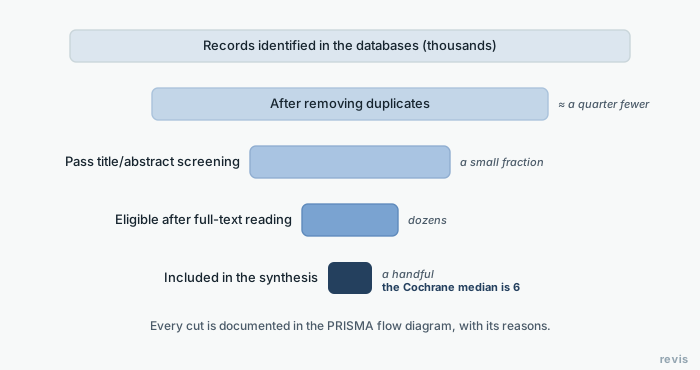
A serious health search easily returns thousands of records. In our guide on [how long a systematic review takes](/en/blog/how-long-does-a-systematic-review-take/) we use 5,000 as a normal volume after removing duplicates, and overlaps between [databases](/en/blog/databases-for-systematic-reviews/) can inflate the initial raw total by another third. From there, each stage cuts. Title and abstract screening discards the vast majority, full-text reading filters out the candidates that looked like a fit and aren't, and the criteria make the final cut. If a search of thousands ends with six included studies, as in the typical Cochrane review, more than 99% of what was identified fell away along the way. That massive, record-by-record documented discard is exactly what the word systematic buys you.
It pays to absorb that proportion before you start, because the funnel's two usual scares are easier to handle if they don't catch you off guard. One is reaching the end with two studies. The other is opening your first export and finding 8,000 records. Neither one, on its own, means the review is badly designed.
## If you get too few (or none)
Before accepting the result, audit the search. A tiny set of results sometimes just means the [search string](/en/blog/literature-search-strategy/) left out synonyms or that a [relevant database](/en/blog/databases-for-systematic-reviews/) for your field is missing. Go through the reference lists of the studies you do have, consider the gray literature and, if you can, ask a librarian or information specialist to review the strategy.
If the search was done well, you have three legitimate options and one trap. You can publish with few studies and say so. You can broaden the criteria through a declared amendment to the [protocol](/en/blog/prospero-registration/), with its date and justification. Or you can turn the work into a [scoping review](/en/blog/types-of-literature-reviews/) if the field turns out to be more scattered than the question assumed. The trap is quietly loosening the criteria until enough studies get in, because that turns the review into a convenience selection dressed up as method.
And with zero? A well-conducted empty review gets published and cited. It records that the question is still unanswered, what evidence was available on the search date and which studies would be needed. For a thesis committee or a journal, a transparent funnel that ends at zero is worth more than an opaque one that ends at twenty.
If your goal was a meta-analysis, two comparable studies are technically enough to [pool effects](/en/blog/what-is-a-meta-analysis/), although with so few the result is fragile and many reviews downgrade it to a supplementary analysis.
## If you get thousands
The opposite scare has a plan too. First, diagnose whether you have too much noise or too much question. You tackle noise by refining the search string with more specific terms, validated methodological filters, and date or language limits that are justified and stated in the protocol. You tackle the question by narrowing it with the [PICO](/en/blog/pico-question/) template, for example with a better-defined population or one primary outcome instead of five. What is not legitimate is cutting by eye once you've seen the results, dropping years or journals until the number becomes manageable, because every cut made after registration smells of convenience.
And if the question is well framed and the volume is what it is, what's left is plain hard work. The numbers are in the guide on how long a review takes. At 45 seconds per abstract and with two reviewers, 5,000 records mean about 125 hours of first-pass screening alone. This is the stage where tools make the biggest difference. In a real review done in revisia, a search of 7,000 records ended with 657 reviewed by hand by the researcher, a pile 90.6% smaller.
Is your export scary? In revisia AI screens every record against your criteria and you review the uncertain band with the quote from the abstract in front of you. Create your free account.
## What the examiners (or the peer reviewer) will ask
When your thesis committee or a journal's peer reviewer looks at your number of studies, the real question is about traceability. Why these and not others. The good answer exists before you start, it's called a protocol, and you show it with the [PRISMA diagram](/en/blog/prisma-flow-diagram/) and the table of excluded studies with their reasons. With that backing, 4 studies are as defensible as 40. Without it, 40 fall apart just like 4.
In revisia that funnel draws itself as you work. The PRISMA diagram fills in with every decision you make, from the total identified to the included studies. Create your free account and see for yourself.
If you are working on an academic project, the guide to the [literature review for a thesis or dissertation](/en/blog/literature-review-for-a-dissertation/) helps you gauge how much depth your case calls for, and the comparison between [systematic and narrative reviews](/en/blog/systematic-review-vs-narrative-review/) helps you pick the format if the funnel gives you a scare in either direction.
## Frequently asked questions
### Is there a minimum number of articles for a systematic review?
No. No methods guidance (Cochrane, JBI, PRISMA) sets a minimum number of included studies. The review is valid if the search was comprehensive, the criteria were defined in advance and the process was documented in the [PRISMA flow diagram](/tools/en/prisma-flow-diagram/). The final number is a result of the method. In fact, the typical Cochrane review includes six trials (Mallett and Clarke 2002).
### How many articles should a systematic review for a thesis or dissertation have?
As many as come out of the funnel with a focused question. In practice that usually means screening hundreds of records and including anywhere from a few studies to a few dozen. More important than the number is being able to show the complete [PRISMA flow diagram](/en/blog/prisma-flow-diagram/) and justify every full-text exclusion. If the volume explodes, narrow the question in the protocol.
### Is a systematic review with few articles, or none, valid?
Yes, if the process was sound. 8.7% of active Cochrane reviews included no studies at all (Yaffe 2012). An empty review documents that the question still has no evidence to answer it, points to the gap and keeps others from repeating the search blind. With few studies, a narrative synthesis and clearly stated limitations carry the publication.
### Can I do a meta-analysis with only two or three studies?
Technically, yes. A pooled effect can be calculated from two comparable studies. Robustness is another matter. With so few, heterogeneity can barely be estimated and the interval comes out wide, so the usual approach is to pair the number with a study-by-study [narrative synthesis](/en/blog/what-is-a-meta-analysis/), or to report only the narrative synthesis.
### How many references are screened compared with how many end up included?
In health research, a search across several databases easily returns thousands of references, and duplicates can inflate the raw total by around a third. After screening, dozens of candidates remain for full-text review, and the final included studies usually number in the single digits or a few dozen. Having about 1% of what you identified survive, or less, is normal.