# How many systematic reviews are published each year?
> How many systematic reviews are published each year? Over 100,000 in 2025 and six times more in a decade, with data from PubMed and OpenAlex, year by year.
Published at https://revisia.es/en/blog/how-many-systematic-reviews-are-published/ · Author: Ángel González de la Flor · Date: 2026-10-12
If you feel that a new systematic review on your topic appears every week, you are not imagining it. The answer to how many systematic reviews are published each year is a little dizzying. Where a decade ago a few thousand came out, today they number in the tens of thousands per year, and they pass one hundred thousand according to the broadest source. This post puts numbers on that feeling and explains where they come from and why the figure depends so much on how you decide to count.
## How many systematic reviews are published each year
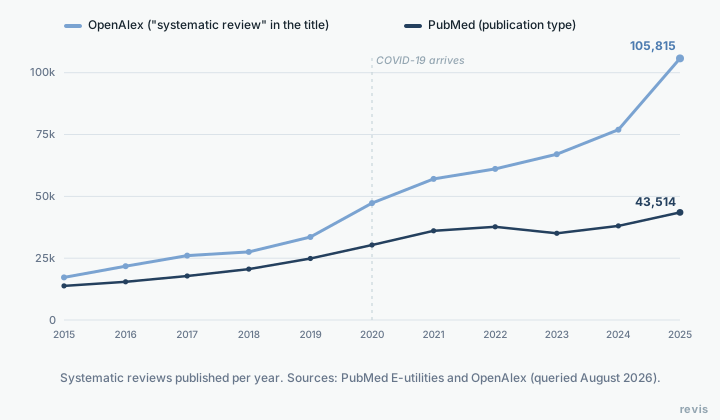
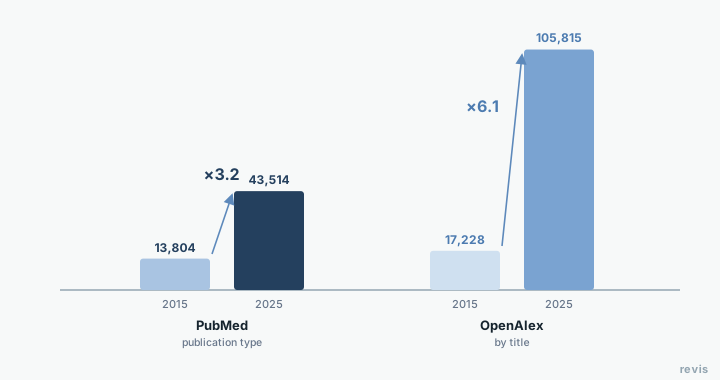
The short answer is more than one hundred thousand in 2025. According to [OpenAlex](https://openalex.org/), the broadest open bibliographic database, **105,815** works with "systematic review" in the title were published, compared with **17,228** in 2015. That is a **6.1-fold** increase in a decade.
If we stick to [PubMed](https://pubmed.ncbi.nlm.nih.gov/) and its stricter official publication type tag, *Systematic Review*, the 2025 figure is **43,514**, compared with 13,804 in 2015. There the multiplier is **×3.2**. Two sources, two different numbers, but they point the same way. Output is rising fast.
Put on a daily scale, those 105,815 works from 2025 come to **about 290 new systematic reviews every day**, holidays included. With PubMed's strict definition, about 120 a day. Keeping up with a field by hand, reading the reviews as they come out, stopped being realistic a long time ago.
## Two ways of counting, and why both matter
The gap between 43,514 and 105,815 is not an error. They are two legitimate ways of counting the same thing.
- **PubMed, by publication type.** The US National Library of Medicine tags each article with its type. `Systematic Review[Publication Type]` is a rigorous definition focused on biomedicine, but it has a catch. NLM **introduced that tag in 2019** and applied it to earlier years retroactively and incompletely, so the older years are somewhat undercounted.
- **OpenAlex, by title.** Counting the works that have "systematic review" in the title covers **every discipline**, not just health, and captures recent output better. In exchange, it lets in some false positives, such as methods guides, protocols or other kinds of review that use the phrase in the title.
Neither one is "the right one". The strict count tells you how many properly tagged biomedical systematic reviews exist; the broad one, how much weight the format carries across science as a whole. That is why, throughout this series, we always state which source each figure uses. If you want to go over exactly what we are counting, the guide on [what a systematic review is](/en/blog/what-is-a-systematic-review/) explains it from scratch, and the comparison of [the types of literature reviews](/en/blog/types-of-literature-reviews/) helps you tell it apart from its relatives.
## The COVID footprint (and an odd dip in 2023)
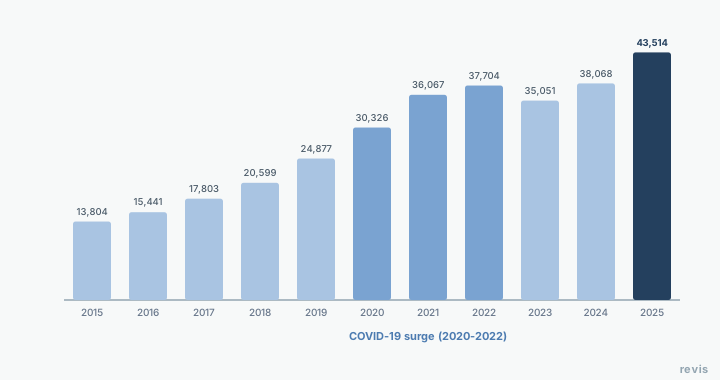
The curve does not rise perfectly smoothly. Between 2019 and 2021 there is a marked acceleration that coincides with the pandemic. In PubMed, the count went from 24,877 reviews in 2019 to 36,067 in 2021, a 45% jump in two years. The urgency to synthesize evidence on COVID-19, and to revisit almost everything else, sent output soaring.
And there is a detail that often goes unnoticed. **2023 was the first year in which PubMed recorded a drop** from the year before (35,051 compared with 37,704 in 2022), before picking up the pace again in 2024 and 2025. A passing bump, not a change in trend, but a reminder that not even this curve rises in a straight line.
## The numbers, year by year
For anyone who wants the full table, these are the two counts we used, queried in August 2026.
| Year | PubMed (publication type) | OpenAlex (by title) |
|---|---|---|
| 2015 | 13,804 | 17,228 |
| 2016 | 15,441 | 21,761 |
| 2017 | 17,803 | 26,062 |
| 2018 | 20,599 | 27,533 |
| 2019 | 24,877 | 33,554 |
| 2020 | 30,326 | 47,291 |
| 2021 | 36,067 | 57,056 |
| 2022 | 37,704 | 61,089 |
| 2023 | 35,051 | 67,059 |
| 2024 | 38,068 | 76,966 |
| 2025 | **43,514** | **105,815** |
In total, OpenAlex holds more than **700,000** works with "systematic review" in the title across its history. The rest of this series uses that corpus to study where those reviews come from: which countries and disciplines they cluster in, which ones are cited most, how many you can read for free, and what problems so much volume brings.
With hundreds of new reviews a day, finding the evidence that matters is the first bottleneck. In revisia AI does the first screening pass and you decide on the uncertain band, always with the quote from the abstract in front of you. Create your free account.
## Why they are growing so fast
Several forces are behind the curve at once. Evidence-based medicine established the systematic review as the top rung of evidence synthesis, and journals and agencies ask for it more and more. The format has spread from health to psychology, the social sciences, education and computer science. And reference management and [study screening](/en/blog/rayyan-vs-covidence/) tools have lowered the barrier to entry, so small teams, and even master's dissertations, can take one on today.
That growth has a less pleasant side. When hundreds are published every day, you get overlap, duplication and reviews that add little to what already existed. It is a serious debate within the field itself, and we devote a whole chapter of this series to whether too many systematic reviews are being published.
## What this means for your work
If you are about to start your own, the practical lesson has two parts. First, something close to your question almost certainly exists already, so search for previous reviews first and [register your protocol in PROSPERO](/en/blog/prospero-registration/) to avoid repeating what has been done. Second, the volume of literature you will have to screen will be high, and that is the stage that takes the most hours; we look at it with data in [how long a systematic review takes](/en/blog/how-long-does-a-systematic-review-take/) and in [how many studies a systematic review needs](/en/blog/how-many-studies-in-a-systematic-review/).
Want to see the math with your own corpus? In revisia you screen with AI and verify with the quote alongside, from the PICO question to the manuscript. Create your free account and try it.
## Frequently asked questions
### How many systematic reviews are published worldwide each year?
It depends on how you count. With PubMed's strict definition (the *Systematic Review* publication type tag), there were 43,514 in 2025. Counting every work with "systematic review" in the title in OpenAlex, which covers all disciplines, there were 105,815 that same year. Both figures have grown sharply over the last decade.
### Why are the PubMed and OpenAlex figures so different?
Because they measure different things. PubMed only counts what its indexers have tagged as a systematic review, mostly in biomedicine, and that tag was applied retroactively from 2019. OpenAlex counts any work with the phrase in the title in any field, which widens coverage but lets in some false positives. For the overall trend, the two agree.
### How many systematic reviews have been published in total?
OpenAlex holds more than 700,000 works with "systematic review" in the title across its whole history. In PubMed, with the strict publication type tag, the cumulative total is around 341,000. Once again, the difference comes down to what each source counts.
### Are they growing faster than the rest of the scientific literature?
Their volume has grown sixfold in a decade according to OpenAlex, a very fast pace. Claiming they grow faster than science as a whole would require comparing against the curve of all publications, which we have not measured here, so we prefer not to claim it. What is certain is that the format carries more and more weight and has spread far beyond medicine.