# The medical topics with the most systematic reviews
> Musculoskeletal pain, stroke, dementia, cancer and diabetes lead the topics with the most systematic reviews. The map by topic, with data from OpenAlex.
Published at https://revisia.es/en/blog/most-studied-topics-systematic-reviews/ · Author: Ángel González de la Flor · Date: 2026-09-07
Which topics get the most systematic reviews? The most studied topics show where clinical uncertainty is concentrated, because researchers tend to review the areas with a lot of scattered evidence and hard decisions to make. With the topic data from [OpenAlex](https://openalex.org/) (automatic groupings of works by subject), that map can be drawn.
## The topics that get reviewed the most
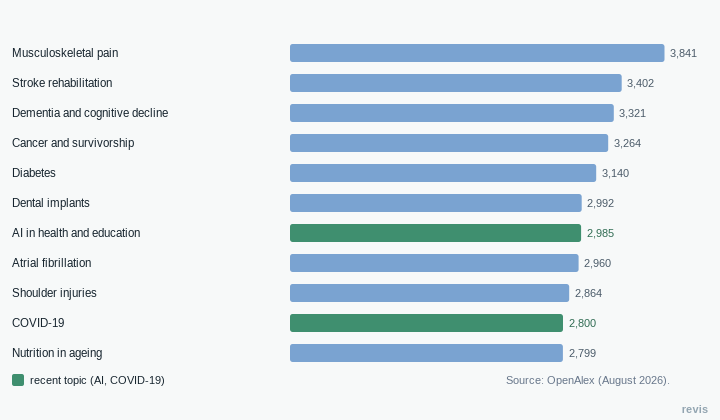
At the top is **musculoskeletal pain and rehabilitation**, with 3,841 systematic reviews, followed by **stroke rehabilitation** (3,402), **dementia and cognitive decline** (3,321), **cancer and survivorship** (3,264) and **diabetes** (3,140). Then, almost level, come **dental implants** (2,992), **artificial intelligence in health and education** (2,985), **atrial fibrillation** (2,960), **shoulder injuries** (2,864), **COVID-19** (2,800) and **nutrition in ageing** (2,799).
There is a clear pattern. Much of the top of the list is **rehabilitation and physiotherapy** (musculoskeletal pain, stroke, shoulder). These are areas with many small, heterogeneous trials, exactly where [a systematic review](/en/blog/what-is-a-systematic-review/) adds the most, by pooling and comparing studies that do not settle the question on their own.
## The newcomers: artificial intelligence and COVID
Two topics near the top reflect very current interests. **COVID-19** (2,800 reviews) appeared from nothing in 2020 and has since built up a huge amount of evidence synthesis. And **artificial intelligence in health and education** (2,985) captures the interest in reviewing, in an orderly way, what works and what does not in a fast-moving field. Seeing both so high, next to diseases studied for decades, shows how much weight these subjects already carry on the research agenda.
## The most studied topic is methodology itself
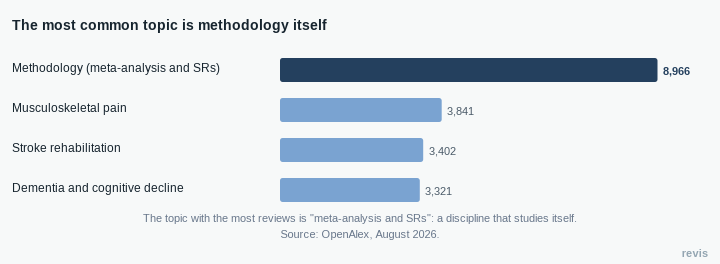
One figure stands out. If we do not filter for clinical topics, the largest group of works is not a disease but **methodology itself**. The topic "meta-analysis and systematic reviews" holds 8,966 works, more than twice the leading clinical topic. It is a discipline that studies itself and publishes constantly on how to do better reviews and how to [avoid their biases](/en/blog/risk-of-bias-assessment/). That effort to refine the method is what keeps it rigorous, and it explains why [the most cited systematic reviews](/en/blog/most-cited-systematic-reviews/) are also methods guides.
revisia puts that method to work with AI-assisted screening that you verify, following PRISMA, whatever your topic. Create your free account.
## What the topic map tells us
This ranking is most useful as a mirror. If your topic is near the top, you have good news and bad news. There is plenty of evidence to synthesise, but also [plenty of previous reviews](/en/blog/too-many-systematic-reviews/), so search carefully before you start to avoid repeating what has been done. If your topic is not there, you may have found a real gap that deserves a review, or an area that is still young. Either way, knowing [which fields systematic reviews are concentrated in](/en/blog/systematic-reviews-by-field/) and [how many are published in total](/en/blog/how-many-systematic-reviews-are-published/) helps you place your work.
These topics are automatic OpenAlex groupings over the corpus of works with "systematic review" in the title (which includes some false positives, such as guides or protocols with that phrase), and they are a 2026 snapshot, not a time series. They show where the effort is concentrated today, not how fast it is changing.
Whatever your topic, in revisia you screen with AI and verify with the quote alongside, from start to finish. Create your free account and try it.
## Frequently asked questions
### Which topics have the most systematic reviews?
Musculoskeletal pain and rehabilitation (3,841), stroke rehabilitation (3,402), dementia (3,321), cancer (3,264) and diabetes (3,140) lead the list. Close behind, almost level, come dental implants, artificial intelligence in health, atrial fibrillation, shoulder injuries and COVID-19.
### Which diseases are reviewed the most?
Among specific conditions, musculoskeletal disorders and rehabilitation, stroke, dementia, cancer and diabetes stand out. These are areas with a lot of evidence scattered across small trials, where a systematic review is especially useful for reaching a joint conclusion.
### Are there systematic reviews on artificial intelligence?
Yes, many. Artificial intelligence in health and education is already one of the topics with the most systematic reviews (2,985), on a par with diseases studied for decades. It reflects the interest in synthesising, in an orderly way, what works in a field that changes very quickly.
### What is the most common topic in systematic reviews?
Methodology itself. The topic "meta-analysis and systematic reviews" holds 8,966 works, more than twice the leading clinical topic. It is a field that studies itself and publishes constantly on how to do better reviews and how to avoid their biases.