# Open access in systematic reviews
> 65.5% of systematic reviews are open access, far above the average for science. Yet almost all of them are in English. The data, from OpenAlex.
Published at https://revisia.es/en/blog/open-access-systematic-reviews/ · Author: Ángel González de la Flor · Date: 2026-09-18
Open access (being able to read a scientific paper for free, with no subscription or fee) matters especially for systematic reviews, because their whole job is to gather and summarise evidence so that other people can use it. A synthesis locked behind a paywall only half does that job. The good news, according to the data, is that systematic reviews are open more often than the rest of science. The less good news has to do with language.
## How many are open access
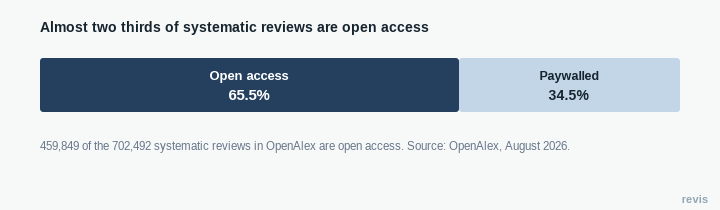
Of the **702,492** systematic reviews recorded in [OpenAlex](https://openalex.org/) (counting works with "systematic review" in the title, a count that lets in some false positives such as guidelines or protocols), **459,849 are open access**, that is, **65.5%**. Two in three can be read without paying. That is a high figure, especially next to the average for the scientific literature.
## More open than average
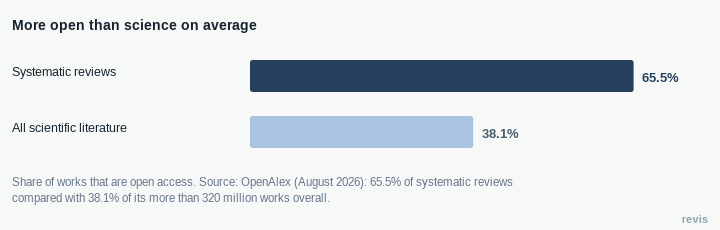
The contrast is large. Across OpenAlex as a whole, which holds more than 320 million works from every discipline, only **38.1%** is open access. [Systematic reviews](/en/blog/what-is-a-systematic-review/), at 65.5%, reach a share 1.7 times higher. Open access mandates from many public funders probably play a part, as does the fact that reviews are written to be consulted and cited, although we have not measured how much each cause contributes.
For anyone doing a review, this is a practical advantage. A good share of the previous reviews you need to check will be available at no cost, which makes the [search](/en/blog/literature-search-strategy/) easier and helps when you retrieve full texts.
## Open, but in English
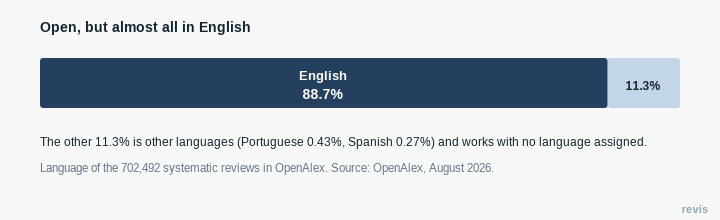
Open access removes the money barrier, but not the language one. **88.7%** of systematic reviews are written in English. The remaining 11.3% is split between languages with a tiny weight (Portuguese, 0.43%; **Spanish, just 0.27%**) and a large pool of works whose language OpenAlex does not manage to classify. A review can be free and still be out of reach for someone who does not read English comfortably.
It is a reminder that "open" and "accessible" are not the same thing. For the many researchers and clinicians whose first language is not English, synthesised evidence is one click away in terms of price but still one language barrier away in practice. It also cuts the other way: if your review only searches English-language sources, you may miss relevant studies published in other languages, which is worth stating as a limitation.
revisia covers the whole process from the PICO question to the manuscript. The AI screens and you verify each decision with the quote alongside. Create your free account.
## How to find open access reviews
If you are looking for systematic reviews you can read in full and for free, there are several routes. Academic search engines flag which works are open access, and sources such as PubMed Central or institutional repositories collect free versions. When you design your [search strategy](/en/blog/literature-search-strategy/) and choose your [databases](/en/blog/databases-for-systematic-reviews/), keep in mind how much of the corpus you will be able to retrieve in full text, because a good part of the [screening work](/en/blog/rayyan-vs-covidence/) depends on it. If you are wondering whether you can skip the subscription databases altogether, we measured it in [do you need Scopus and Web of Science for your systematic review](/en/blog/systematic-review-without-scopus-web-of-science/).
And if you wonder how much synthesised evidence is out there waiting, the answer is in [how many systematic reviews are published each year](/en/blog/how-many-systematic-reviews-are-published/). It is more than a hundred thousand a year, and two in three are open.
Going to review that evidence? In revisia you screen with AI and verify with the quote alongside, from start to finish. Create your free account and try it.
## Frequently asked questions
### What percentage of systematic reviews are open access?
According to OpenAlex, 459,849 of the 702,492 systematic reviews it records can be read for free. That is 65.5%, roughly two in three.
### Are they more often open access than other studies?
Yes, by a wide margin. The open access average across all the scientific literature in OpenAlex is 38.1%, so systematic reviews (65.5%) are 1.7 times more likely to be open. Open access mandates from many public funders probably play a part, as does the fact that reviews are written to be consulted and cited.
### What language are systematic reviews written in?
88.7% are in English. Other languages take up very little room. Portuguese accounts for 0.43% and Spanish for only 0.27%; much of the remaining 11.3% is works with no language assigned. Open access does not change that language imbalance.
### How do I find open access systematic reviews?
Academic search engines flag which works are open access, and sources such as PubMed Central or institutional repositories collect free versions. When you plan your search, it is worth checking how much of what you retrieve you will be able to read in full at no cost.