If your question calls for a systematic method, you do not have to build that method yourself. In revisia the whole workflow is guided, from the PICO question to the PRISMA diagram. Create your free account.
## The systematized review, the middle ground almost nobody mentions Between the two poles there is a format with its own name that most guides overlook. The classic typology by [Grant and Booth (2009)](https://pubmed.ncbi.nlm.nih.gov/19490148/), which describes 14 review types, calls it a **systematized review**. It borrows elements of the systematic method (a structured question, a documented search, explicit selection criteria), but it deliberately stops short of the full standard. It is almost always written by one person, who cannot do dual screening or search every relevant database. The authors themselves describe it as "typically conducted as postgraduate student assignment". That is where its value lies for an undergraduate thesis or a master's dissertation screened alone. It gives you a defensible method without promising what you cannot deliver. The key is that the limitations are declared, not hidden. "Search in two databases, screening by a single reviewer, no formal bias assessment" is an honest sentence that examiners understand and respect. In practice you declare it in the work itself. Call your review a systematized review in the title or in the methods section, and list there what it does not cover from the full standard. What examiners do not forgive is finding those same limitations when nobody declared them. If you are weighing more formats (scoping review, rapid review, umbrella review), the full map is in the guide to [types of literature reviews](/en/blog/types-of-literature-reviews/). ## Which one to choose for your thesis or dissertation 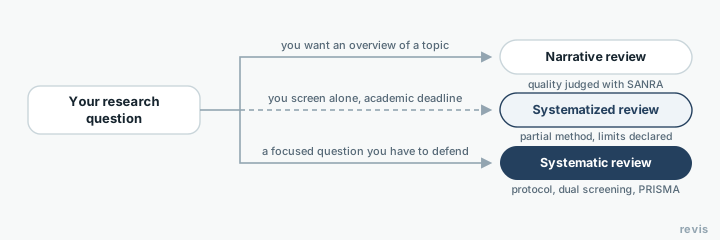 Four questions are enough to place yourself. Answer them in order, and be honest with the second one. 1. **Is your question specific or broad?** "Does intervention X work for problem Y?" calls for a systematic method, in health and in any other field. "What is known about topic Z?" calls for a narrative review or, if you want to map the evidence with a method, a scoping review. 2. **How much calendar time do you really have?** A full systematic review rarely takes less than several months of steady work. If your deadline is ten weeks away, planning a full systematic review is planning to miss it. 3. **Are you screening alone?** Independent dual screening is part of the standard. Without a second person, the most defensible option is a systematized review that says so, not a "systematic" review that keeps quiet about it. 4. **What do your supervisor and examiners expect?** Some master's programs expect a systematic review as the final project, and some committees value a well-argued narrative review more. That conversation with your supervisor is worth more than any guide. To see how each format fits into the structure of the whole project, read the guide to the [dissertation literature review](/en/blog/literature-review-for-a-dissertation/). ## The mistake that fails you (in both directions) Worse than picking the wrong format is dressing one format up with the other's name, and it is the most common error. The classic version is calling a piece of work a "systematic review" when it has no protocol, a single-database search that nobody could repeat and no written selection criteria. A journal reviewer or a methodologist on the committee spots it within minutes, because the first things they look for are the protocol, the search string and the flow diagram. A badly done systematic review is not a narrative review. It is a systematic review you cannot defend. The reverse also happens. You present as an "expert" narrative review something that actually needed a method, for example when the conclusion of the work is a practice recommendation. If your review ends with "therefore, X should be done", the question was specific and the evidence had to be gathered systematically. The examiner who reads that recommendation will ask how you know the study that contradicts it was not left out, and a hand-picked selection has no answer to that. The rule is short. The name of the format is a methodological promise, and the reader will check whether you keep it. ## From narrative to systematic, step by step Another way to understand the border is to cross it. Turning a narrative review into a systematic one has little to do with "working harder" and a lot to do with adding four specific pieces, in this order: 1. **Close the question.** Go from "what is known about X?" to a question with a defined population, intervention, comparison and outcome. The [PICO](/en/blog/pico-question/) framework exists for exactly this. 2. **Write the protocol before the formal search.** Which databases, which criteria, how disagreements get resolved. [Registering it in PROSPERO](/en/blog/prospero-registration/) fixes the rules while they are still cheap to change. 3. **Turn the search into a search string.** Go from following references to a [documented strategy](/en/blog/literature-search-strategy/) that anyone can run in the same [databases](/en/blog/databases-for-systematic-reviews/) and get the same results. 4. **Screen against written criteria.** Each record passes or fails according to the [inclusion and exclusion criteria](/en/blog/inclusion-and-exclusion-criteria/), with the exclusion reason recorded for the flow diagram. Seen this way, it is also clear what makes the jump expensive: volume. An exhaustive search multiplies the number of records, and [screening is the phase that takes the most hours](/en/blog/rayyan-vs-covidence/) in the whole method. Keep in mind that a tool speeds up that first pass and the checking, but it does not replace the second reviewer of the full standard. If you screen alone with help from artificial intelligence, your format is still a systematized review, declared as such.That mechanical part is the one you can compress. In revisia artificial intelligence does the first screening pass and you check each decision with the quote from the abstract in front of you, even if you screen alone. Create your free account and try it with your question.
## Frequently asked questions ### Can a narrative review count as an undergraduate thesis or master's dissertation? It depends on what your program and your supervisor ask for. As the literature review inside an empirical project, a narrative review is the natural format. As the whole project, many examiners accept it if it is well argued, although more and more master's programs expect at least a systematized review, with a documented search and explicit criteria. Confirm it with your supervisor before you decide on the method, not after. ### What is the SANRA scale? SANRA (Scale for the Assessment of Narrative Review Articles) is a scale published by Baethge, Goldbeck-Wood and Mertens in 2019, in the journal Research Integrity and Peer Review, for rating the quality of narrative reviews. It has 6 items scored from 0 to 2 (12 points maximum), covering the justification of the article, its aims, the description of the literature search, referencing, scientific reasoning and the presentation of data. ### What is a systematized review? It is the named middle ground in the Grant and Booth (2009) typology. It borrows elements of the systematic method, such as a documented search and explicit selection criteria, but it does not meet the full standard, usually because only one person screens. It is a common and defensible format in academic work, as long as its limitations are declared. ### How many references does a narrative review need? There is no published standard number, and be wary of anyone who gives you one. The size depends on the topic and on the journal or degree program. The quality criterion is not quantity but whether the key claims are backed by relevant citations, which is exactly what the referencing item of SANRA scores. ### Can I turn my narrative review into a systematic review halfway through? You can, but it costs more than starting from scratch with a method, because almost everything you have done has to be redone to make it reproducible. The search has to be rewritten as a documented search string, the selection has to be repeated against written criteria, and the protocol has to be fixed before that new selection. If you are considering it, do it as early as possible and register the protocol at that point.