# Are too many systematic reviews being published?
> Over 100,000 a year, and 185 meta-analyses on a single question. The problem of overproduction and redundancy in systematic reviews, with data.
Published at https://revisia.es/en/blog/too-many-systematic-reviews/ · Author: Ángel González de la Flor · Date: 2026-09-15
More than a hundred thousand systematic reviews were published worldwide in 2025, six times more than a decade earlier. That growth has a positive side, which we cover in [how many systematic reviews are published each year](/en/blog/how-many-systematic-reviews-are-published/). But when anything is produced at that pace, duplication and waste follow. The uncomfortable question is whether we really need this many systematic reviews, or whether too many are being published.
## Growing faster than science
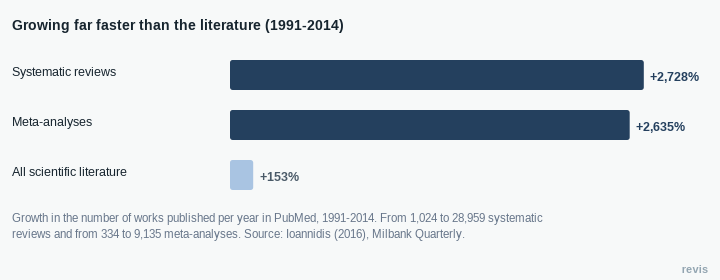
The starting figure comes from [John Ioannidis in 2016](https://pmc.ncbi.nlm.nih.gov/articles/PMC5020151/), in a widely cited article in *The Milbank Quarterly*. Between 1991 and 2014, the number of systematic reviews published per year grew by **2,728%** (from 1,024 to 28,959) and the number of [meta-analyses](/en/blog/what-is-a-meta-analysis/) by **2,635%**. Over the same period, the scientific literature in PubMed as a whole grew by only **153%**. In other words, evidence synthesis is growing far faster than the evidence it synthesises.
When output grows faster than the evidence itself, it is fair to ask where so many new reviews come from and whether all of them meet a real need.
## The redundancy problem
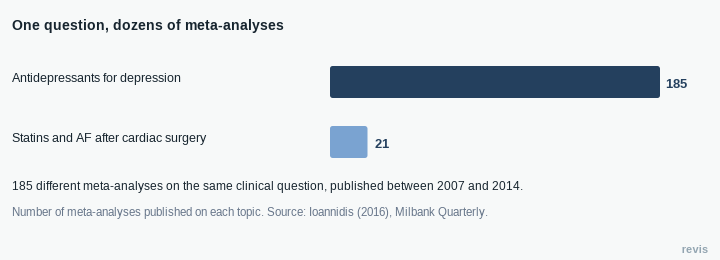
The most visible symptom is repetition. Ioannidis documented extreme cases, among them **185 different meta-analyses on antidepressants for depression** published between 2007 and 2014, and **21 meta-analyses** on statins to prevent atrial fibrillation after cardiac surgery. That is 185 answers to the same question, often overlapping and sometimes contradicting each other.
When dozens of teams synthesise the same evidence separately, the result is often more confusion than knowledge. Readers find several reviews on their topic and cannot tell which one to trust. Nor is this an isolated case. The fact that the topic with the most systematic reviews is [methodology itself](/en/blog/most-studied-topics-systematic-reviews/) shows that the field has been worried about this problem for years.
## How many are surplus, according to Ioannidis
Ioannidis's estimate is harsh. Looking at published **meta-analyses**, he calculated that about **one in six** were clearly misleading (mostly meta-analyses of genetic association studies), about **one in three** were redundant or unnecessary, and of the rest, roughly half had serious methodological flaws. His much-quoted conclusion is that "**possibly the large majority of produced systematic reviews and meta-analyses are unnecessary, misleading, and/or conflicted**", and that they often work more as easy publishable units or marketing tools than as contributions to the evidence.
These figures should be read for what they are: the judgement of an influential author, not a universal measurement. But the underlying diagnosis, overproduction and redundancy, is widely recognised.
## How to make sure your review adds something
The good news is that avoiding the problem is in your hands, and the practices that help also make your work better.
- **Search before you start.** Check whether a recent, good-quality review on your exact question already exists. If there is one and it is well done, updating it may be more useful than repeating it (keeping reviews up to date is a challenge even for [Cochrane](/en/blog/cochrane-in-numbers/)).
- **Register the protocol.** A [protocol in PROSPERO](/en/blog/prospero-registration/) makes your intention public and helps others avoid duplicating your work (and you theirs).
- **Justify why yours is needed.** If reviews already exist, explain whether the new one adds recent studies, a sounder method or a different population.
- **Take care of the method.** Much of the problem is about quality. Many reviews are poorly conducted. A serious [risk of bias assessment](/en/blog/risk-of-bias-assessment/) and a reproducible search make the difference between adding to the evidence and getting in its way, and they help you avoid carrying forward [studies that are later retracted](/en/blog/retracted-systematic-reviews/).
A rigorous review costs less when the mechanical part does not eat your time. In revisia the AI screens and you verify with the quote in front of you, so you can spend your time on judgement. Create your free account.
## So, are there too many?
The answer needs a nuance. [Systematic reviews](/en/blog/what-is-a-systematic-review/) as a format are not the surplus; they are still the best way to synthesise evidence. The surplus is the reviews done without checking whether they were needed and without the rigour the method demands. The aim is not to publish less for its own sake. It is for each new review to add something that was not already there. Done that way, a systematic review is never one too many.
Planning one that adds something? In revisia you screen with AI and verify with the quote alongside, from start to finish. Create your free account and try it.
## Frequently asked questions
### Are too many systematic reviews being published?
Many voices within the field think so. Their number is growing much faster than the scientific literature as a whole (+2,728% between 1991 and 2014, against +153% for all literature, according to Ioannidis), and that overproduction brings redundancy and waste. The format is not the problem; the unnecessary or poorly conducted reviews that pile up are.
### How many systematic reviews are redundant?
There is no single figure, but the examples are striking. 185 meta-analyses on antidepressants for depression were published in just seven years. Looking at meta-analyses, Ioannidis (2016) estimated that about one in three is redundant or unnecessary, on top of one in six that is clearly misleading (mostly genetic association studies).
### What is research waste?
It is the share of research that adds no value. Studies that are poorly designed, never published, badly reported or simply unnecessary because they repeat what is already known. Redundant systematic reviews are a clear example. They use up time and resources without adding new knowledge.
### How do I avoid doing a redundant systematic review?
First check whether a recent, good-quality review on your exact question already exists. Register your protocol in PROSPERO to make your intention public. And if reviews already exist, justify what yours adds (more studies, a better method, a different population). If a good review exists but is out of date, updating it is usually more useful than starting from scratch.