Fundamentals / By the numbers
Which fields of science produce the most systematic reviews?
The systematic review was born in medicine, and that is still where its centre of gravity lies. More than half of all those published are biomedical. But the format has travelled, and that is the interesting part. Here are the numbers by discipline.
Which fields of science produce the most systematic reviews? The short answer is almost all of them, but very unevenly. The systematic review is a creature of medicine, and that is still where most of the output comes from. The method, though, left health a long time ago and now has a presence in many disciplines far from where it started. With data from OpenAlex, which counts by title and therefore lets in some false positives (methods guides or software with the phrase in the title), the split is easy to see.
Medicine dominates, by a long way
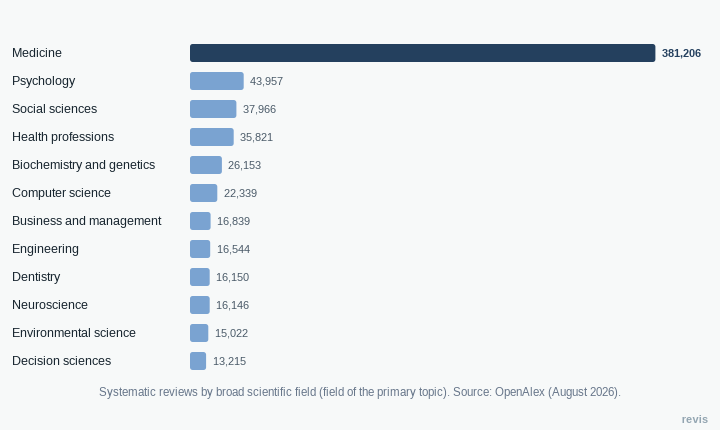
One glance is enough. Medicine accounts for 381,206 systematic reviews, almost nine times more than the second field. Far behind come psychology (43,957), the social sciences (37,966) and the health professions (35,821). The scale is so uneven that the other disciplines barely show up on the chart.
It makes historical sense. The systematic review and evidence-based medicine grew up together, with the Cochrane Collaboration as their engine since the 1990s. The habit of synthesising all the available evidence before deciding on a treatment is far more deeply rooted in clinical practice than in other fields.
More than half of everything
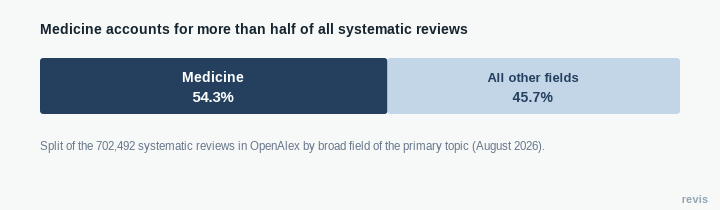
As a proportion, the figure is even more striking. Medicine accounts for 54.3% of all the systematic reviews recorded in OpenAlex. In other words, more than one in every two reviews published worldwide, on any subject, is biomedical. No other discipline comes anywhere near that share.
Beyond medicine
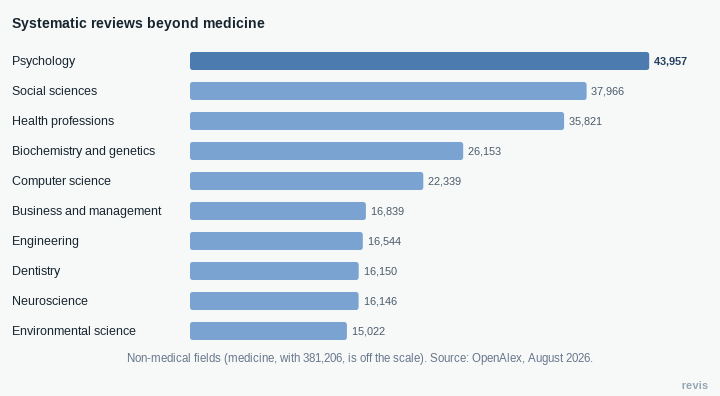
Once medicine is taken off the scale, the map becomes more varied. Psychology leads the non-medical fields, followed by the social sciences and the health professions. Further down, with thousands of reviews each, come biochemistry and genetics (26,153), computer science (22,339), engineering, business and management and environmental science.
The fact that computer science already has more than twenty-two thousand systematic reviews says a lot. Engineering and computing popularised their own variant, the systematic literature review, to synthesise in a reproducible way what is known about a technical problem. The systematic review has become a tool used across science, not something reserved for people in white coats.
These figures are a 2026 snapshot, not a time series. They show where each field stands today, not how fast each one is growing.
Whatever your discipline, the method is the same. revisia supports the whole process, from the PICO question to the manuscript, with AI-assisted screening that you verify. Create your free account.
Why the method travels
The appeal is the same everywhere. Unlike a narrative review, where the author chooses what to cite, a systematic review starts from a defined question, a documented search and criteria fixed in advance. That rigour, developed to decide on treatments, works just as well for synthesising what works in education or what the evidence says about a public policy. If you are unsure which format suits your project, we compare them in types of literature reviews.
The other driver is practical. As reference managers and screening tools have lowered the barrier to entry, a systematic review no longer needs a large clinical team. That has let disciplines with less tradition join in.
What this split means for you
If you are about to do your own, this map of systematic reviews by discipline holds a couple of lessons. First, if you work outside medicine, you will run into fewer previous reviews, but also fewer guides written for your field, so lean on the general standards (such as PRISMA). Second, the choice of databases changes a lot from one discipline to another. PubMed is the heart of biomedicine, but in the social sciences or computer science other kinds of sources lead. If you want to know which specific works collect the most citations, we look at that in the most cited systematic reviews; for the overall volume, start with how many systematic reviews are published each year.
Whatever your field, in revisia you screen with AI and verify with the quote alongside, from start to finish. Create your free account and try it.
Frequently asked questions
Which field publishes the most systematic reviews?
Medicine leads by a huge margin. It has 381,206 systematic reviews according to OpenAlex, almost nine times more than the second field, psychology (43,957). Medicine accounts for 54.3% of all systematic reviews in the world.
Are systematic reviews done outside medicine?
Yes, in many disciplines. Among the non-medical fields, psychology, the social sciences, the health professions, biochemistry, computer science (with more than 22,000), engineering, business and management, and environmental science stand out. The method now runs across the whole of science.
How much of the total do medical systematic reviews make up?
More than half. Medicine accounts for 54.3% of the 702,492 systematic reviews recorded in OpenAlex. No other discipline comes close, which reflects the method's origins in evidence-based medicine.
Is a systematic review in computer science the same as one in medicine?
The method is the same (a defined question, a documented search, explicit criteria), but the conventions and sources differ. In engineering and computing the term systematic literature review is common, and the reference databases are not the biomedical ones. The reproducible rigour, however, is identical.
54.3% of all systematic reviews are in medicine, almost nine times more than psychology. Computer science already has more than 22,000. Which fields produce the most?
via revisia