Method / By the numbers
The most cited systematic reviews (and why almost all of them are guidelines)
Sort the works with "systematic review" in the title by citations and the list is dominated by methods guidance (above all PRISMA and the Cochrane Handbook), not by clinical findings. PRISMA 2020 has passed 100,000 citations. This is what that list says, read properly.
What are the most cited systematic reviews of all time? The answer is revealing, but it has to be read with care, because it hides a trap that says a lot about how this field works. Sort the works with "systematic review" in the title by number of citations and what comes out on top is not a set of major clinical findings. It is the handbooks on how to conduct and report a review.
The most cited
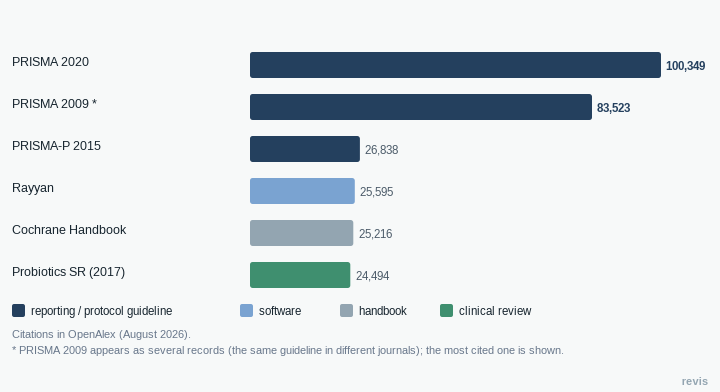
At the very top is PRISMA 2020, the reporting guideline for systematic reviews, with 100,349 citations. It is followed by PRISMA 2009 (its previous version, which appears several times because it was published simultaneously in different journals and takes up several places in the top 10 on its own; its most cited record has 83,523), the protocol extension PRISMA-P (26,838), the screening tool Rayyan (25,595) and the Cochrane Handbook (25,216). Only then, in tenth place, does the first real clinical systematic review appear: a 2017 synthesis on probiotics with 24,494 citations.
Almost none of them is a systematic review
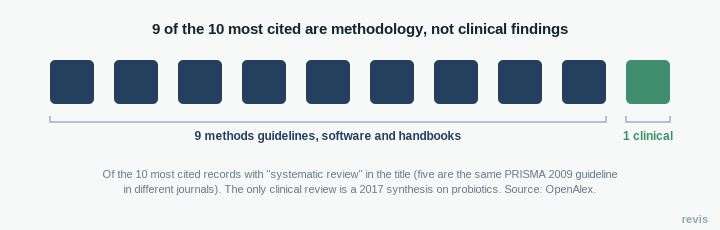
Of the ten most cited works with "systematic review" in the title, nine are not systematic reviews. They are reporting guidelines (the different versions of PRISMA), a software tool (Rayyan) and a handbook (Cochrane's). They make the list because they have the phrase in the title, but none of them reports results on a clinical question.
Several of those records are actually the same document. The PRISMA 2009 statement was published in several journals at once, and each version collects its own citations, so on its own it fills a good part of the top 10. If PRISMA were counted only once, the list would still be dominated by methodology, but it would show even more clearly how little individual clinical studies weigh against the guidelines.
Why methods take all the citations
The fact that the most cited work is a reporting guideline is not an anomaly. It is a sign of how a discipline matures. Almost every systematic review published today cites PRISMA to state that it follows its standards, and many use Rayyan or Covidence for screening and the Cochrane Handbook as their methods reference. Each new review adds one more citation to those tools. They are the invisible infrastructure everything else is built on, which is why they rack up numbers no single finding can match.
It is the same reason a statistics paper or a laboratory method often outscores, in citations, the discoveries it makes possible. Tools get used again and again; each finding is cited within its own field.
revisia follows the standards that dominate that list. It works to PRISMA 2020 and covers the screening stage, where Rayyan and Covidence rule, with AI that you verify. Create your free account.
The only clinical review in the top 10
The exception is worth a closer look. The most cited systematic review with clinical content on the list is a 2017 synthesis on probiotics, with 24,494 citations. It is a good reminder that for a specific review to collect tens of thousands of citations, it has to touch one of the most studied topics in systematic reviews. The vast majority of reviews, however good, are cited within their niche and little more. If you are wondering how many studies are normal to handle, we look at it in how many studies a systematic review needs.
What this list tells us
The fact that methods guidance is the most cited material means the research community has agreed on how a systematic review should be done, and that this agreement (PRISMA, Cochrane, the screening tools) is now as valuable as the results themselves. For anyone starting their own review, the lesson is simple. Build on those standards from the start. Our guides on what a systematic review is and on the PRISMA flow diagram set you on that path, and screening with Rayyan or Covidence covers the stage that shows up most on this list. And if you want the big picture of how much evidence is produced, start with how many systematic reviews are published each year.
Planning a review with a sound method? In revisia you screen with AI and verify with the quote alongside, following PRISMA. Create your free account and try it.
Frequently asked questions
What is the most cited systematic review ever?
If you sort works with "systematic review" in the title by citations, the first is PRISMA 2020, with more than 100,000 citations. But PRISMA is not a systematic review. It is the guideline for reporting them, with its own flow diagram. The most cited review with clinical content on the list is a 2017 synthesis on probiotics, with 24,494 citations.
Why does PRISMA have so many citations?
Because almost every systematic review published today cites PRISMA to state that it follows its reporting standards. Each new review adds a citation, so the guideline builds up figures no single study can match. On top of that, the PRISMA 2009 statement was published in several journals at once, and each version collects its own citations.
Is Rayyan a systematic review?
No. Rayyan is a software tool for screening references, not a review. It appears among the most cited works because its 2016 launch article has "systematic review" in the title and almost everyone who uses the tool cites it. We compare it with other options in the guide to screening with Rayyan and Covidence.
How many citations does a review need to be among the most cited?
In this group, the figures range from PRISMA 2020's 100,000-plus down to the 24,494 of the clinical review that closes the top 10. These are extraordinary numbers, reserved for methods guidance or for reviews on very broad topics. An ordinary systematic review, however solid, sits orders of magnitude lower.
PRISMA 2020 has passed 100,000 citations. Of the ten most cited works with "systematic review" in the title, nine are methods guidelines, software or handbooks.
via revisia