Fundamentals / Planning
How long does a systematic review take?
Over a year is normal, according to the studies that have measured it. A good share of those hours goes into a few mechanical stages that can be compressed. Here is the published data, stage by stage.
How long does a systematic review take? Longer than almost everyone estimates at the start. The studies that have measured it put the average at more than a year of work. The figure is not there to discourage anyone. It helps you plan realistically, and it hides some good news. Many of those hours go into mechanical, repetitive tasks, and those can now be compressed without touching the rigor. The published data is detailed enough to answer stage by stage, and to point out where you can shorten the timeline without the review ceasing to be systematic.
The data puts the average at over a year
At least three independent sources have measured it, each with its own method, and they reach a similar conclusion.
- Borah and colleagues (2017, BMJ Open) followed 195 systematic reviews registered in PROSPERO through to publication and measured an average of 67.3 weeks from protocol registration to published article, about fifteen and a half months, with some projects finishing in under six months and others taking more than two years.
- Michelson and Reuter (2019) estimated the total effort at 1.72 person-years per review. The figure rests on three earlier estimates: a minimum of six months at 10 to 20 hours a week, an average of sixteen months for teams of about five co-authors, and one to two years for a Cochrane review. The authors' calculation averages the first two.
- The Galter Health Sciences Library guide (Northwestern University) adds data from the field. Teams working with a librarian take an average of 12.5 months from protocol to completed review.
Be careful when you quote these figures, because they do not measure the same thing. Borah measures calendar time (how many months pass between registering the protocol and publishing) and Michelson and Reuter measure effort (how many hours of work the whole team adds up). You need both to plan. Calendar time tells you when you will have results, and effort tells you how many hours you will have to carve out of your schedule.
How long a systematic review takes, stage by stage
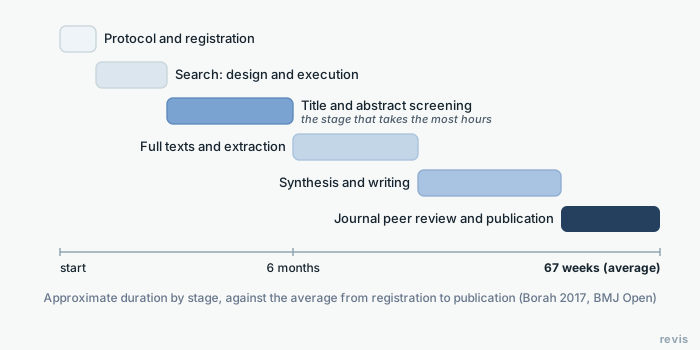
The total looks daunting as a single block, but split by stage it is clear where it comes from. These are the published or approximate times for each stage of the method (if any stage is unfamiliar, they are explained one by one in the guide on what a systematic review is).
| Stage | Typical time | Source |
|---|---|---|
| Designing the search strategy | 2-4 weeks | Galter guide, Northwestern |
| Running the searches in the databases | 2-4 weeks | Galter guide, Northwestern |
| Title and abstract screening | 30-60 seconds per abstract and reviewer (average ≈ 45 s) | Studies that have timed screening |
| Retrieving full texts | 7-10 days per 50 citations | Galter guide, Northwestern |
| Full-text screening | 4-20 minutes per article | Published estimates (Polanin and colleagues, 2019, assume 20 minutes) |
| Data extraction | 36-107 minutes per included study | Timing studies published in 2025 |
| Synthesis, writing and peer review | Several months | Borah 2017 (by difference from the total time) |
The table leaves out the protocol, which has no published standard time but rarely takes less than a couple of well-spent weeks (and PROSPERO registration adds its own wait). It also mixes units on purpose, because some rows give calendar time (weeks, days) and others give effort per record (seconds, minutes) that you will have to convert into hours based on your volume. The math comes right below. And the search timeline hides highly specialized work. Librarians who take part in systematic reviews spend an average of 30.7 hours of their own time on each one (Bullers 2018), mostly designing the search string and translating it across databases.
Screening is the bottleneck
People who have timed the process agree that title and abstract screening is the stage that takes the most hours in the whole review. Picture a search that returns 5,000 records after removing duplicates, a normal volume for a health question.
5,000 records × 45 seconds per abstract × 2 independent reviewers ≈ 125 hours for the first screening round alone.
That is more than three weeks of full-time work saying yes or no to abstracts. Add the deduplication beforehand, chasing PDFs (7 to 10 days per 50 citations) and full-text reading of the candidates that pass the filter. None of those hours go into thinking. It is pure grunt work, but someone has to do it.
It depends on volume, of course. With 500 records, the first double screening round takes about 12.5 hours, and with 10,000 it climbs to 250, a whole quarter at half time. To gauge what volume to expect and how many studies usually survive the funnel, see the guide on how many studies a systematic review needs. That is why it pays to invest in a precise search strategy and well-defined inclusion and exclusion criteria before you open the first database.
Screening is the most daunting part. In revisia AI does the first pass and you decide on the uncertain band, always with the quote from the abstract in front of you. Create your free account.
The work that is still yours
There is a part of the work that no tool will do for you, and you should be clear about it before looking for shortcuts. A systematic review is, above all, an exercise in judgment. You have to frame a question worth asking and decide which evidence counts and which does not. Then you interpret results that sometimes contradict each other, write an honest discussion and defend the work to the journal's reviewers. That intellectual work takes months of calendar time, and it is exactly your contribution as a researcher. No tool replaces it. Be wary of any tool that promises to.
The data itself says so. A good share of the 1.72 person-years estimated by Michelson and Reuter goes into thinking, team discussion and writing rather than repetitive tasks.
What can be compressed (and by how much)
The rest of the time is mechanical work, and that can be compressed: deduplicating, screening thousands of abstracts, chasing full texts, moving data into tables and keeping the PRISMA flow diagram counts consistent through to the end.
In revisia, AI screens each record against your criteria and separates the clear yeses and clear noes from the uncertain band. You review that band and the included records, with the verbatim quote from the abstract alongside so you can check each decision in seconds. The doubts are not resolved on their own or in the background. They are put in front of you with the evidence, and you decide them.
There are numbers measured in real use. In one review done in revisia, out of 7,000 records retrieved, the researcher only had to review 657 by hand, 90.6% fewer. In hours of work, the savings in the mechanical stages range from 30 to 120 hours depending on the size of the corpus. And that estimate is conservative, because it uses the fastest published screening rate, 30 seconds per abstract. At the average published rate, about 45, it comes out even higher. The calendar feels it too. The first pass over thousands of records is no longer measured in weeks, and the pace is set by your review of the uncertain band instead of the whole pile.
How to shorten the timeline without losing rigor
None of what follows is a trick. It is standard practice done well, and each point targets a known source of delay.
- Protocol before search. Changing the criteria halfway through screening means screening again. A protocol registered in PROSPERO fixes the rules while they are still easy to change.
- Put into the search what you want to save in screening. The sharper the search string, the less noise you will have to screen later. If your university offers support from a librarian, use it, because it is expert work measured in tens of hours. Our guides on databases and the search strategy give you the basics.
- Before you dive into the thousands, have both reviewers screen the same 50-100 records and measure the disagreement. An ambiguous criterion caught in the sample saves arguments and rescreening later.
- Deduplicate before screening. Overlap between databases can inflate the corpus by a third. A reference manager or the screening tool itself sorts it out in minutes.
- Use dedicated tools for the mechanical work. For classic blinded double screening, Rayyan and Covidence are the veterans, and revisia adds a verifiable AI first pass and the complete workflow.
- Keep traceability up to date. Recording exclusion reasons as you go saves you from reconstructing them at the end for the PRISMA flow diagram.
- And if the deadline rules, change the format, not the rigor. A rapid review or a scoping review relaxes steps of the method in a declared, legitimate way. Dressing up an express review as systematic, on the other hand, costs you in peer review.
Want to see the math with your own corpus? In revisia you screen with AI and verify with the quote alongside, from the PICO question to the manuscript. Create your free account and try it.
Frequently asked questions
Can you do a systematic review in a month?
A full systematic review, with a protocol, a search across several databases, double screening, extraction and synthesis, will hardly fit in one calendar month when the published average is over a year (Borah 2017). What does fit in weeks is the mechanical part, if you lean on tools, and there are shorter formats (rapid reviews, scoping reviews) that state their limitations. If the deadline cannot move, narrow the question and the number of databases from the protocol on.
How long does a systematic review take for an undergraduate thesis or a master's dissertation?
The academic calendar sets a different scale, with a narrow question, two or three databases and a corpus of hundreds of records, not thousands. At that size, three to six calendar months of steady work is a reasonable range if you plan from the start. Remember to state the limitations (for example, if you screen alone) and take a look at the guide on the literature review for a dissertation. If you are still torn between formats, first compare systematic review vs narrative review.
How long does screening alone take?
At published rates (30 to 60 seconds per abstract and reviewer), double screening 1,000 records takes 17 to 33 hours of human work for the title and abstract stage alone, plus full-text reading of the candidates (4 to 20 minutes per article). It is the part of the process that takes the most hours and the first place where tools are worth using.
Does working as a team shorten the time?
The calendar time, yes. The total hours, no, because independent double screening doubles them in exchange for controlling bias, although more hands let you split the full-text reading and the extraction. The sixteen-month average reported by Michelson and Reuter (2019) refers to teams of about five authors. Working alone is possible (and common in academic work), but you need to state it as a limitation.