Fundamentals / By the numbers
Which countries publish the most systematic reviews?
The United States, the United Kingdom and China lead the world in systematic review output, and between them they hold almost half of the top 15. But the traditional map is shifting. Here are the numbers by country.
The list of countries that publish the most systematic reviews shows a world of evidence still dominated by the English-speaking countries, but with new names that were not there a decade ago. With data from OpenAlex on the table, this is the picture of who produces the world's evidence synthesis.
The countries at the top
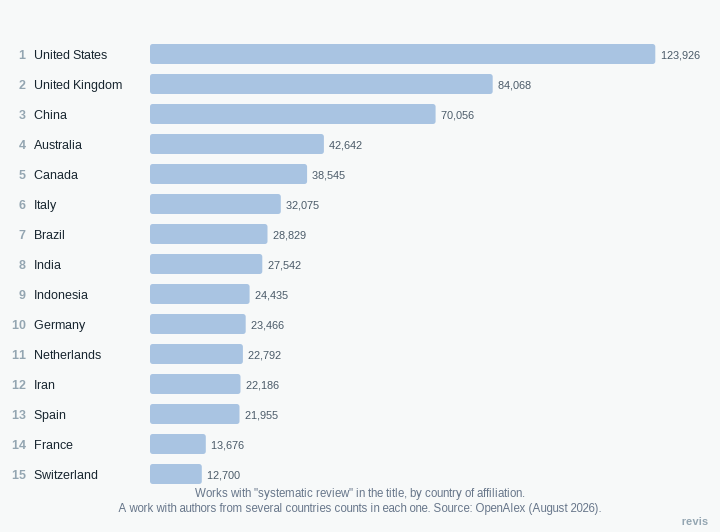
The United States tops the table with 123,926 systematic reviews, followed by the United Kingdom (84,068) and China (70,056). Some way behind come Australia (42,642), Canada (38,545) and Italy (32,075). Further down, the second half of the table is very close, with Germany, the Netherlands, Iran and Spain all between 21,000 and 24,000. It is the split you would expect from world science as a whole. The big research powers are also the big producers of evidence synthesis.
A very concentrated podium
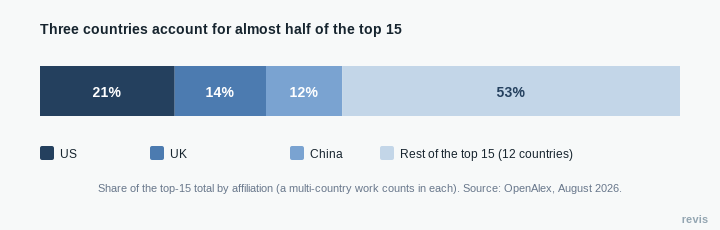
The first lesson is inequality. Just three countries, the United States, the United Kingdom and China, account for almost half (47%) of all the systematic reviews in the top 15. The United States alone contributes one in five of the works on that list. That share is calculated on the sum of mentions per country, with the same double counting we explain below, so read it as a snapshot of relative weight, not as a count of unique works. Evidence synthesis, like research in general, is concentrated in a few scientific systems with funding, journals and a methodological tradition.
The traditional split is shifting
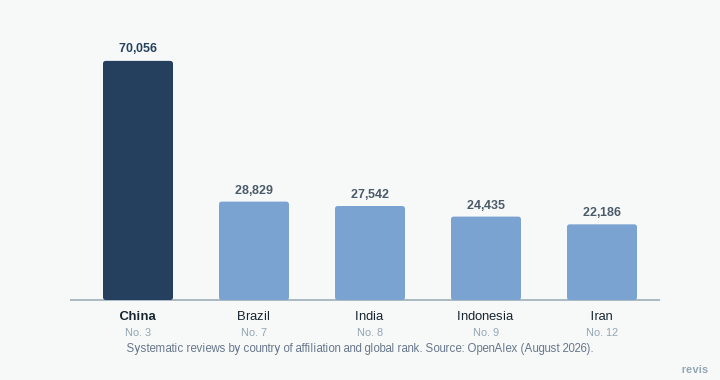
Alongside the usual powers, the top 15 includes several countries that were never part of the traditional English-speaking club of the systematic review. China is already third, behind only the United States and the United Kingdom, and ahead of every country in continental Europe. Further down come Brazil (7th), India (8th), Indonesia (9th) and Iran (12th). Producing synthesised evidence is no longer an exclusively Western affair.
The systematic review is increasingly global. revisia supports the whole process, from the PICO question to the manuscript, with AI-assisted screening that you verify. Create your free account.
Be careful adding up countries (and with "Europe wins")
It is tempting to add up the European countries in the top 15 (the United Kingdom, Italy, Germany, the Netherlands, Spain, France and Switzerland) and announce that "Europe produces more than the United States". That is not a valid comparison, and it is worth understanding why.
These figures count each work once for every country that signs it. A review with authors from the United Kingdom, Germany and Spain counts in all three at once. That is why national totals cannot be added up to get a real European total. Such a "total" would count many reviews two or three times. What can honestly be said is that Europe has many countries in the top 15, but none of them on its own comes close to the volume of the United States.
What this concentration means
Concentration has consequences. Much of the world's synthesised evidence is produced in English and in a handful of countries, which shapes which questions get studied and which settings are best covered. The rise of China, Brazil, India and Indonesia is starting to diversify that picture, although the weight of the English-speaking countries is still enormous.
For anyone doing their own review, the map is a practical reminder. Most of the literature is in English, but not all of it, so your search strategy and your choice of databases decide how much of this world you actually see. And although two in three reviews are open access, almost all of them are in English. If you want the full picture of how much evidence is being produced, start with how many systematic reviews are published each year.
Preparing your review? In revisia you screen with AI and verify with the quote alongside, from start to finish. Create your free account and try it.
Frequently asked questions
Which country publishes the most systematic reviews?
The United States, with 123,926 works with "systematic review" in the title according to OpenAlex, followed by the United Kingdom (84,068) and China (70,056). The count is by the authors' country of affiliation.
How does Europe's output compare with the United States?
There is no clean sum to answer that. Europe has seven countries in the top 15, but the per-country figures cannot be added up into a European total, because a work signed by authors from several countries counts in each of them. What is true is that no single European country reaches the volume of the United States; the closest is the United Kingdom.
Which emerging countries stand out in systematic reviews?
China is already the third-largest producer in the world, ahead of all of continental Europe. The top fifteen also includes Brazil (7th), India (8th), Indonesia (9th) and Iran (12th), countries that were not near the top of the table a decade ago.
Can the figures for several countries be added together?
No. The per-country count adds one for each country that signs each work, so an international review appears in several at once. Adding countries gives inflated totals that count the same reviews several times. The figures are useful for comparing countries with each other, not for building regional totals.
The US, the UK and China account for almost half of the systematic reviews in the global top 15. China is already third, ahead of every country in continental Europe.
via revisia