Fundamentals / Core guide
What is a systematic review?
A type of study that gathers, appraises and synthesizes all the evidence on a defined question, using an explicit and reproducible method. This guide walks through its stages one by one, plus the mistakes worth avoiding.
A systematic review is a secondary study that gathers, appraises and synthesizes all the available evidence on a well-defined research question, following an explicit, transparent and reproducible method. In one sentence, it is the opposite of an opinion. Instead of citing the studies the author remembers or likes, it finds every relevant study, assesses its quality and combines the results using rules set in advance. That disciplined way of working is what makes it the foundation of evidence-based medicine and one of the most reliable sources for clinical, academic and health policy decisions.
This guide explains what a systematic review is, how it differs from a literature review or a narrative review, what its stages are and how to do one step by step. It is the central article of our blog on systematic review methods. From here we link to a dedicated guide for each stage, from the PICO question to the PRISMA flow diagram, so you can go deeper wherever you need to.
What is a systematic review?
A systematic review is a piece of research whose subjects are not patients or primary data. Its subjects are other studies that have already been published (and, when possible, unpublished literature too). Its defining feature is the systematic method. Every decision, from the question to the inclusion criteria, is set out in a protocol before you start and documented so that any other team could repeat the process and arrive at the same set of studies.
The Cochrane Handbook for Systematic Reviews of Interventions puts it this way: "A systematic review attempts to collate all the empirical evidence that fits pre-specified eligibility criteria in order to answer a specific research question." JBI (formerly the Joanna Briggs Institute) frames it in much the same way and provides methods for different types of question (effectiveness, prevalence, experiences and so on). Those two references, together with the PRISMA 2020 statement (Preferred Reporting Items for Systematic Reviews and Meta-Analyses), make up the methodological framework we follow throughout this guide.
What a systematic review is for
A well-conducted systematic review lets you:
- Summarize what is known about a specific question without the bias of picking only the studies that confirm an existing idea.
- Resolve contradictions between individual studies that point in different directions, by weighing their quality and, where appropriate, combining them statistically in a meta-analysis.
- Spot evidence gaps, meaning questions that still lack enough studies, or enough good ones.
- Ground clinical practice guidelines, public policy and academic work (undergraduate theses, master's dissertations, PhD theses) on a reproducible base. If yours is a thesis or dissertation, we have a dedicated guide on the literature review and the systematic review in a dissertation.
Six features separate it from any other review: an explicit research question, inclusion and exclusion criteria set in advance, a reproducible search across several databases, study selection by two independent reviewers, a formal risk of bias assessment, and a transparent synthesis (narrative or quantitative).
Systematic review vs literature review and narrative review
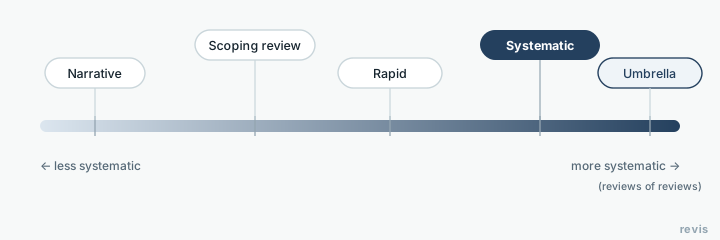
One of the most common mix-ups is treating "systematic review" and "literature review" as synonyms. They are not. A systematic review is a specific method. "Literature review" is a generic term that covers many ways of reviewing the literature, the narrative review included. The key difference is how systematic the process is and how much it controls bias. A systematic review defines everything in advance and documents every step. A narrative review usually depends on the author's judgment.
The table below sums up the main differences. If you are not sure which one to do, the extended comparison and decision guide has its own article. For a full classification of review formats (scoping, umbrella, integrative, rapid), see our guide on the types of literature reviews.
| Aspect | Systematic review | Literature / narrative review |
|---|---|---|
| Research question | Specific and structured (e.g. PICO) | Broad, general, often implicit |
| Protocol in advance | Yes, registered (e.g. PROSPERO) | Usually not |
| Search strategy | Explicit, reproducible, across several databases | Not described or not reproducible |
| Inclusion/exclusion criteria | Defined before you start | Vague or missing |
| Study selection | By two independent reviewers | By the author, with no bias control |
| Quality assessment | Systematic (risk of bias) | Optional or missing |
| Synthesis | Structured; sometimes a meta-analysis | Interpretive discussion |
| Reproducibility | High (another team reaches the same result) | Low |
A narrative review is not "bad" by definition. It is useful for giving a broad overview of a wide topic or for introducing a field. The problem is different, and it shows up when a narrative review is presented as if it were systematic, claiming a methodological strength that its way of working (no protocol in advance, no reproducible search, no independent double review) simply cannot guarantee.
Is yours a systematic review? In revisia you work through every stage with guidance, with each decision documented. Create your free account.
The stages of a systematic review (overview)
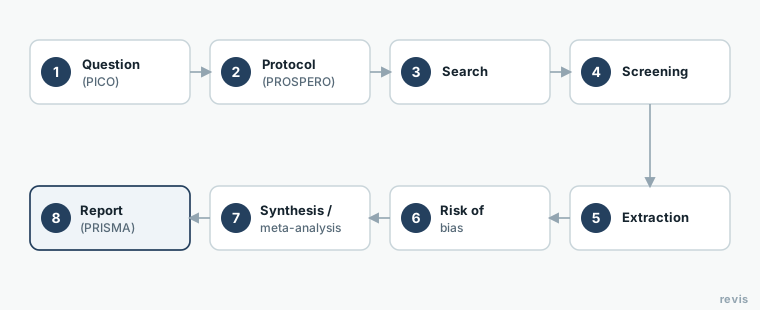
Doing a systematic review is a process in stages. Each stage feeds the next, and all of them are documented so the result can be reproduced. There are eight, and each one links to a detailed guide where we explain it step by step.
1. Research question (PICO)
Everything starts with a clear question. A vague question produces a vague review. The most widely used framework to structure it is PICO: Population, Intervention, Comparison and Outcome. Defining these four components well hands you, almost for free, your search terms and your inclusion criteria. PICO is built for interventions. For exposures, scoping, prevalence, diagnosis, prognosis or experiences, you can choose among seven question frameworks.
Learn how to frame your question, with examples by discipline, in our guide on how to build your research question with the PICO model. And if you want to see how that question ends up in the manuscript, we analyzed what 2,368 published reviews do with theirs. They write a declarative objective of about 26 words, almost never a question with a question mark.
2. Protocol and registration (PROSPERO)
Before you search for a single article, you write a protocol. It sets in advance the question, the eligibility criteria, the search strategy, the selection methods, data extraction and the synthesis plan. Registering it (in health, the usual place is PROSPERO, the international register of systematic reviews) reduces the risk of bias. It stops the criteria from shifting along the way to "fit" the results you are finding, and it makes your intentions public before you know the outcome.
The protocol is the document that makes your work verifiable, not a bureaucratic formality. PRISMA even has a dedicated extension for protocols, PRISMA-P.
3. Search strategy
The search must be comprehensive and reproducible. That means translating your PICO question into a search string with Boolean operators (AND, OR, NOT), controlled vocabularies (MeSH terms in PubMed, DeCS in Spanish- and Portuguese-language databases) and truncation, and running it in several databases, not just one.
We show you how to build that string step by step in the guide on the literature search strategy with Boolean operators and MeSH, and which sources to use in the one on databases for a systematic review. The general rule in Cochrane and JBI guidance is to search more than one database so you do not depend on the coverage of a single one.
4. Screening and selection
The search returns far more results than will end up being relevant (the full funnel, with how many studies usually remain at the end, has its own guide). Now you filter. Screening happens in two steps. First on title and abstract, then by reading the full text of the records that passed the first filter. To control bias, two reviewers assess each record independently, and disagreements are resolved by consensus or by a third reviewer.
Who gets in and who does not is decided by your eligibility criteria, which you should have defined precisely. We explain how to derive them from PICO in the guide on inclusion and exclusion criteria. To manage thousands of records and work blinded, dedicated tools are the practical choice; we compare them in the guide on Rayyan vs Covidence for study screening.
5. Data extraction
From the studies that pass screening, you extract the data of interest systematically, ideally with a data extraction form designed and piloted in advance. You record the population characteristics, the details of the intervention, the sample size, the outcome measures and the numerical data for a possible synthesis. The screening rule applies again here. Two people should extract independently and compare their results to reduce transcription and interpretation errors. We cover the table fields, how to pilot the form and the typical mistakes in the data extraction guide.
6. Risk of bias assessment
Not every included study deserves the same weight. Before drawing conclusions you need to assess their risk of bias and methodological quality, and each study design has its own tool: RoB 2 for randomized controlled trials, ROBINS-I for non-randomized studies, the Newcastle-Ottawa Scale for observational studies, AMSTAR 2 for appraising other reviews, and the GRADE approach for rating the overall certainty of the evidence.
This stage is what separates a rigorous review from a collection of studies. We cover it in the guide on risk of bias assessment with RoB 2, AMSTAR 2 and Newcastle-Ottawa.
7. Synthesis and meta-analysis
With the studies selected and appraised, it is time to synthesize. The synthesis can be narrative (structured and honest about its limitations) or quantitative. When the studies are similar enough in population, intervention and outcome, their results can be combined statistically in a meta-analysis, which produces a pooled estimate of the effect (with its forest plot, its confidence interval and its heterogeneity analysis).
A meta-analysis is not always possible or desirable. If the studies are too heterogeneous, combining them can produce a misleading number. How to read a forest plot, what a high I² means and when a meta-analysis makes sense (or not) are all explained in our guide on meta-analysis and how to interpret it.
8. Reporting according to PRISMA
The review is reported following the PRISMA 2020 statement, the international standard for reporting systematic reviews and meta-analyses completely and transparently. PRISMA includes a 27-item checklist and the well-known flow diagram showing how many records were identified, screened, excluded (and why) and finally included.
You will find the editable template and the guide to filling it in in the article on the PRISMA 2020 flow diagram. PRISMA does not change your results, but it makes your review assessable and publishable; many journals require it.
Recommended tools
You do not need paid software to do a rigorous systematic review. What does save weeks of work and cut errors along the way is the right tool at each stage. Here is a selection; each category links to its detailed guide.
| Stage | Tools | What for |
|---|---|---|
| Search | Databases. PubMed/MEDLINE, Scopus, Web of Science, Cochrane Library, SciELO | Find the evidence across several sources |
| Reference management | Mendeley or Zotero (free), EndNote (paid) | Organize references, remove duplicates, cite in Word |
| Screening | Rayyan (free) or Covidence (paid) | Blinded selection of titles, abstracts and full texts |
| Synthesis / meta-analysis | Meta-analysis software. JASP, jamovi, RevMan, R (metafor package) | Calculate the pooled effect and draw the forest plot |
One practical tip. Define your workflow before you start and keep each stage traceable to the next. For example, the exclusions you log in Rayyan or Covidence must match the numbers you later put in the PRISMA flow diagram. When the tools talk to each other (or at least their numbers add up), the final report writes itself.
Common mistakes
Knowing the most frequent errors saves you repeated work and criticism in peer review. These are the ones that come up most:
- A question that is too broad or poorly defined. If the question is not structured (with PICO, for example), the search gets out of hand and the review loses focus.
- Not registering the protocol. Changing the criteria along the way to fit the results is a classic source of bias. A protocol written in advance (ideally registered in PROSPERO) prevents it.
- Searching a single database. Sticking to PubMed leaves out evidence indexed in Scopus, Web of Science or regional and non-English databases. Cochrane and JBI recommend several sources.
- Not documenting the search strategy. If your search cannot be reproduced, it is not a systematic review.
- Screening and extracting with a single reviewer. Without independent double review, the risk of error and selection bias shoots up.
- Skipping the risk of bias assessment. Combining good and poor studies as if they were worth the same distorts the conclusions.
- Forcing a meta-analysis on heterogeneous studies. A summary number from studies that are not comparable is worse than no number at all.
- Reporting the review incompletely. Leaving out the flow diagram or PRISMA items makes the review impossible to assess and harder to publish.
Would you rather not get lost in the process? In revisia you do the review guided stage by stage, from the PICO question to the manuscript. Create your free account and get started.
Frequently asked questions
What is the difference between a systematic review and a literature review?
A systematic review follows an explicit, reproducible method (a protocol, a documented search and criteria set in advance). "Literature review" is a generic term that guarantees none of those controls. The dimension-by-dimension comparison with the narrative review, and which one suits each case, is in systematic review vs narrative review.
Do I need to register a protocol?
It is strongly recommended and more and more often required. Registering the protocol in PROSPERO before screening reduces bias, and many journals ask for the registration number.
Can I do a systematic review on my own?
You can, but screening and extraction by two independent people is the standard way to reduce errors. If you work alone, keep a record of the borderline decisions.
How long does a systematic review take?
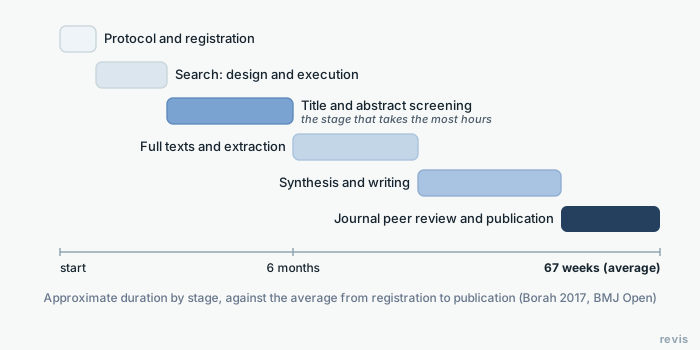
The published average is over a year: 67.3 weeks from protocol registration to publication (Borah 2017), because screening, extraction and risk of bias assessment need two reviewers working independently. Shorter formats, such as the rapid review or the scoping review described in the guide on the types of reviews, cut the timeline by openly relaxing steps of the method. The stage-by-stage breakdown, with every figure and where you can save time, is in the guide on how long a systematic review takes.
What is the difference between a systematic review and a meta-analysis?
They are not the same, although they often go together. A systematic review is the whole method for identifying, selecting, appraising and synthesizing evidence. A meta-analysis is only one synthesis technique, the statistical procedure that combines the results of several studies into a pooled estimate of the effect. Every systematic review has a synthesis stage, but that synthesis can be narrative; you only run a meta-analysis when the studies are similar enough. Put another way, you can have a systematic review without a meta-analysis, but a rigorous meta-analysis should start from a systematic review. We cover it in the guide on what a meta-analysis is and how to interpret it.
How many reviewers do you need?
At least two independent reviewers for screening, data extraction and risk of bias assessment, with a third reviewer (or team consensus) to resolve disagreements. This double review is one of the features that controls bias and sets a systematic review apart from a narrative review written by one person. Both the Cochrane Handbook and JBI stress this point. You can do a review alone (for example, for an undergraduate thesis), but then you should state that limitation explicitly.
What is PRISMA?
PRISMA (Preferred Reporting Items for Systematic Reviews and Meta-Analyses) is the set of international guidelines for reporting systematic reviews and meta-analyses transparently and completely. The current version, PRISMA 2020, includes a 27-item checklist and a flow diagram that tracks studies from identification to final inclusion. PRISMA does not tell you how to do the review (Cochrane and JBI cover that). It tells you how to report it so anyone can appraise and reproduce it. The template and the full guide are in the article on the PRISMA 2020 flow diagram.