Method / Question
Research question frameworks: PICO, PECO, PCC, CoCoPop, PIRD, PEO or SPIDER?
PICO is useful, but it doesn't fit everything. This guide compares the seven frameworks available in revisia, adds PICo for qualitative synthesis and explains when you should follow a more specific guide.
If you want to know whether a treatment works, PICO fits well. If you want to estimate how many people have a condition, it forces you to invent an intervention and a comparator that don't exist. That is where you need CoCoPop. A scoping review usually starts with PCC. For a qualitative synthesis, JBI recommends PICo. SPIDER can help organize the search and the criteria, but it doesn't replace that recommendation in every case. Those are the research question frameworks this guide compares.
Choosing a framework is not about memorizing acronyms. It is about recognizing what answer you are after. That decision shapes the question, the inclusion criteria and the way you search. A wrong box can narrow the review before you find the first article.
This comparison doesn't try to list every possible framework. It focuses on the seven that revisia can suggest today and shows their limits. The tool doesn't yet structure PICo, PICOTS, ECLIPSE or other specialized mnemonics.
Research question frameworks: choose by what you want to find out
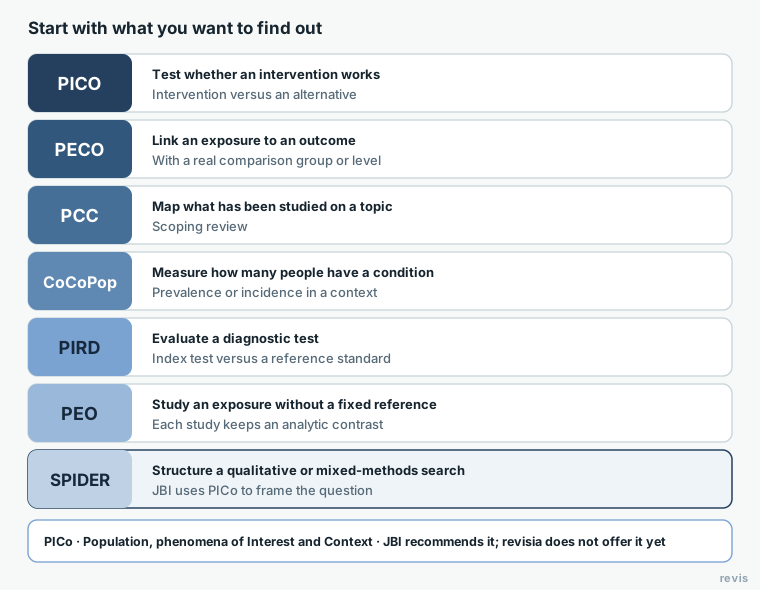
| I want to find out | Framework | Elements |
|---|---|---|
| Whether an intervention produces an effect | PICO | Population, Intervention, Comparison, Outcome |
| Whether an exposure is associated with an outcome, with a comparison | PECO | Population, Exposure, Comparator, Outcome |
| What has been studied on a topic | PCC | Population, Concept, Context |
| How many people have a condition | CoCoPop | Condition, Context, Population |
| How accurately a test detects a condition | PIRD | Population, Index test, Reference test, Diagnosis of interest |
| How an exposure influences an outcome without a common reference | PEO | Population, Exposure, Outcome |
| How people experience or perceive a phenomenon | SPIDER | Sample, Phenomenon of Interest, Design, Evaluation, Research type |
| How a phenomenon is experienced within a context | PICo | Population, phenomena of Interest, Context |
This classification follows the question types covered in the JBI Manual and the methods literature on review types. It is not a hierarchy. A framework with five boxes is not more rigorous than one with three. It fits when its boxes match real decisions in the protocol.
The same decision can show up in different places. CoCoPop can treat the time period as part of the context, PICo includes context in the acronym, and PEO leaves time and setting outside its three letters. That is not a contradiction. Follow the methods guidance you chose and document where you set each limit.
Write the question however it comes out. revisia suggests one of the seven frameworks it offers and flags possible gaps. It can get it wrong, and it doesn't offer PICo yet. You review every field before saving it. See which framework revisia suggests.
PICO to test the effect of an intervention
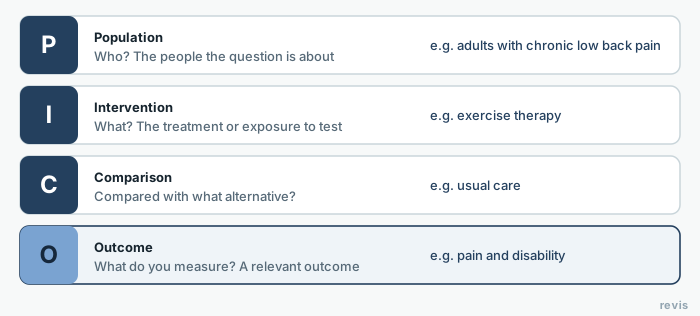
PICO answers questions about treatment, prevention and other compared interventions. Its elements are population, intervention, comparison and outcome. The key word is intervention. Someone deliberately applies a treatment, program or practice, and its effect is compared with an alternative.
One example would be evaluating the effects of metformin versus sulfonylureas on cardiovascular complications in adults with type 2 diabetes.
- Population: adults with type 2 diabetes.
- Intervention: metformin.
- Comparison: sulfonylureas.
- Outcome: cardiovascular complications.
Our guide to the PICO question explains how to tune each element and turn it into a search. PICO stops fitting when the question contains no intervention, or when the goal is to map a field, estimate frequency or understand experiences.
PECO to study an exposure with a comparison
PECO swaps the intervention for an exposure. It is used to study associations in etiology or risk when there is a reference group, level or condition that matters from the protocol stage.
Imagine you want to determine the association between long-term exposure to traffic noise and high blood pressure in the adult urban population, compared with living in low-noise areas.
- Population: adult urban population.
- Exposure: long-term traffic noise.
- Comparator: living in low-noise areas.
- Outcome: high blood pressure.
The exposure is not assigned like a treatment. It is observed. That difference separates PECO from PICO, even though both have four boxes and share population, comparison and outcome.
PCC to map a field
PCC is usually used in scoping reviews. The goal is to describe what evidence exists, how a topic has been studied and where the gaps are. These questions tend to be broader than effectiveness reviews, but they can also have precise limits.
For example, you could map the evidence on the use of telemedicine for people receiving palliative care in rural areas.
- Population: people receiving palliative care.
- Concept: use of telemedicine.
- Context: rural areas.
JBI recommends PCC for scoping review questions and asks you to align those elements with the objective, eligibility, screening and extraction. It also acknowledges that some questions can drop an element or need another framework. The current JBI guidance on PCC lets you check those nuances.
PCC doesn't turn every loosely defined topic into a scoping review. First you have to decide whether you want to map a field or answer a narrow question about effects, associations or frequency.
CoCoPop for prevalence and incidence questions
CoCoPop structures questions that measure how often a condition occurs in a population and a context. The JBI Manual proposes it for systematic reviews of prevalence and incidence.
One example would be estimating the prevalence of iron-deficiency anemia in women of reproductive age seen in primary care.
- Condition: iron-deficiency anemia.
- Context: primary care.
- Population: women of reproductive age.
There is no intervention or comparator here. Nor does the condition work like a PICO outcome. It is the thing whose frequency you want to estimate. If you are studying incidence, you also need to define the period in which new cases are counted, even though time is not one of the letters in CoCoPop.
PIRD for diagnostic accuracy
PIRD is for when you want to know how a test performs against a method that establishes the reference condition. A clean example is determining the accuracy of a rapid antigen test versus laboratory RT-PCR for detecting influenza in adults with acute respiratory symptoms.
- Population: adults with acute respiratory symptoms.
- Index test: rapid antigen test.
- Reference test: laboratory RT-PCR applied to the whole sample.
- Target condition: influenza virus infection.
A different question would be whether using ultrasound reduces unnecessary procedures or speeds up care. There you are measuring the clinical effect of a practice, and PICO may be the right fit. PIRD measures accuracy. It is not enough for a diagnostic test to appear in the sentence.
PEO for an exposure without a comparison box
PEO uses population, exposure and outcome. It fits when you don't want to fix a comparison box in the question.
For example, determining the association between different levels of exposure to traffic noise and high blood pressure in the adult urban population, without imposing a common reference category on every study.
- Population: adult urban population.
- Exposure: traffic noise.
- Outcome: high blood pressure.
The line between PEO and PECO is drawn in the protocol. If it requires a specific reference group or level, use PECO. If it doesn't reserve a box for that reference, PEO saves you from inventing one. The studies still need variation in the exposure and some analytic contrast, such as categories, dose-response or continuous change.
PEO is not the full standard for a formal prognosis review. The 2026 Cochrane handbook for prognosis reviews recommends PICOTS, which adds the index prognostic factor or model, comparator, timing and setting.
SPIDER for experiences and perceptions
SPIDER was created as an alternative tool for turning qualitative and mixed-methods questions into a search strategy. It has since also been used to organize questions and criteria through sample, phenomenon of interest, design, evaluation and research type.
One example would be exploring perceptions of family support among people with diabetes, drawing on qualitative interview studies.
- Sample: people with diabetes.
- Phenomenon of Interest: family support.
- Design: interviews.
- Evaluation: perceptions.
- Research type: qualitative studies.
JBI recommends PICo for framing qualitative synthesis questions. SPIDER can add detail on design and study type, but it doesn't require you to turn its five boxes into five blocks joined with AND. In a published comparison of SPIDER and PICO, SPIDER produced a more specific search but missed five relevant studies in the case analyzed.
The three decisions people mix up most
PICO or PECO
Ask who determines the central element. If the research team applies a treatment, program or practice, start with PICO. If it observes an exposure such as pollution, smoking or noise, start with PECO.
PECO or PEO
Look for a comparison that is part of the question. It could be an unexposed population, another level of exposure or a reference condition. If there is one and it determines eligibility, use PECO. If you don't want to fix it in advance, use PEO. Dropping the C doesn't remove the analytic contrast that lets you estimate an association.
PICO or PCC
Look at the kind of final answer. PICO tries to estimate an effect between alternatives. PCC aims to describe the extent, characteristics and gaps of a field. A broad PICO question doesn't become PCC just because it is poorly focused.
Paste your question in plain language. revisia suggests PICO, PECO, PCC, CoCoPop, PIRD, PEO or SPIDER. It can get it wrong, and it doesn't replace the methods guidance behind your protocol. You can correct or reject every field. Try my question for free.
The framework is not the search strategy
The framework does three related jobs. It helps you write the question, anticipates the eligibility criteria and supplies concepts for the search. It doesn't require you to search for every element.
An intervention search usually works best with population and intervention. Adding outcome and comparator can remove relevant articles, because they don't always appear in the title or abstract. In SPIDER, requiring design, evaluation and research type can cause the same problem. In PIRD, the test and the condition usually supply the core concepts.
The sensible order is this:
- Write the full question.
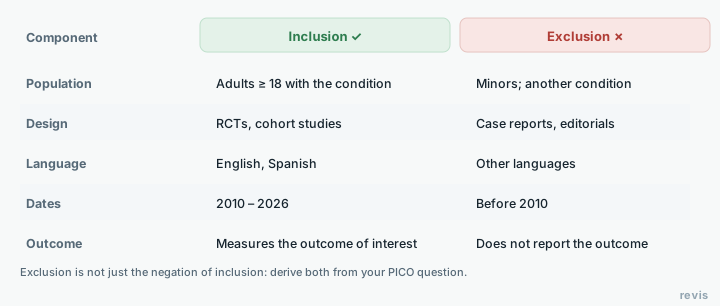
- Turn each element into clear criteria.
- Test several search combinations.
- Check whether you retrieve studies you already know about.
- Document the final version so it can be reproduced.
The search strategy guide explains how to combine controlled vocabulary, synonyms and operators without confusing the question with the search string.
Templates for writing your question
- PICO Evaluate the effect of [intervention] versus [comparison] on [outcome] in [population].
- PECO Determine the association between [exposure] and [outcome] in [population] compared with [comparator].
- PCC Map the evidence on [concept] in [population] within [context].
- CoCoPop Estimate the prevalence or incidence of [condition] in [population] within [context].
- PIRD Determine the accuracy of [index test] versus [reference test] for detecting [target condition] in [population], with [clinical role and threshold] where relevant.
- PEO Determine the association between [exposure] and [outcome] in [population] without fixing a common reference category.
- SPIDER Explore [evaluation] of [phenomenon] in [sample] through [design] in [type] studies.
- PICo Explore [phenomena of interest] in [population] within [context]. revisia doesn't offer this template yet.
These templates help you get started. Next, turn the question into a declarative objective and check that every term decides something real in the protocol.
Frequently asked questions
Which framework is used for a systematic review?
It depends on the question. PICO fits interventions, PECO and PEO fit exposures, CoCoPop fits frequency, PIRD fits diagnostic accuracy and PCC fits scoping reviews. JBI recommends PICo for framing qualitative syntheses. SPIDER can help organize their search and eligibility.
Can I use PICO for any question?
PICO works well for the effects of interventions. Forcing it onto prevalence, experiences, scope or diagnostic accuracy creates artificial boxes. In those cases, choose a framework built for the answer you are looking for.
What is the difference between PICO and PCC?
PICO compares the effect of an intervention on an outcome. PCC organizes population, concept and context to map a field in a scoping review. The difference lies in the purpose of the review.
What is the difference between PECO and PEO?
PECO keeps a box for the comparison. PEO doesn't. Use PECO when a specific reference group or level is part of the protocol. PEO lets you accept different contrasts across studies, but it doesn't remove the need to compare levels, categories or changes in the exposure.
Do I have to use every part of the framework in the search?
No. The framework should appear in full in the question and the criteria, but a search can leave out the comparator, outcome, design or other parts that cut sensitivity too much. You need to test the strategy and check that it retrieves relevant studies.
How do I know if I chose the right framework?
Read the question without the acronym and say what answer you expect. An effect, an association, a map of the field, a frequency, the accuracy of a test, a prognosis or an experience. If the boxes describe that answer without inventing elements, the framework probably fits.
Methods sources consulted in September 2026. Living manuals, such as JBI and Cochrane, may update their recommendations.
Start with your own sentence. revisia suggests a framework and flags possible gaps. It can get it wrong, and you review every field before saving it. The suggestion doesn't replace the methodological decisions in your protocol. Check my question for free.