Method / Question
How to write a PICO question, with examples
Learn how to write a PICO question for intervention reviews without mixing up outcomes, eligibility criteria and the search strategy. With worked examples.
The PICO model turns a question about the effects of an intervention into a structured research question. Its name covers Population, Intervention, Comparison and Outcome. A good PICO question is useful in nursing, medicine, psychology and other fields whenever you compare an intervention with an alternative.
PICO is not the first step of every systematic review, and it does not work equally well for every design. A scoping review, a qualitative synthesis, a prevalence question or a diagnostic test accuracy review need other decisions. Even in an intervention review, the question, the inclusion criteria and the search strategy are not exact copies of one another.
What the PICO model is
The PICO model is an evidence-based practice tool that breaks a question about interventions into manageable parts. Richardson and colleagues described the approach in 1995. The Cochrane Handbook uses it to frame reviews of effects and then to separate the general review question from the specific comparisons that will be synthesized.
A question like "does exercise help depression?" is too broad to answer rigorously. The PICO format forces you to say who you mean, which specific intervention you are evaluating, what you compare it with and what outcome you expect. That gets you to a question you can answer by finding and synthesizing specific studies.
A well-built PICO question helps with these decisions:
- It sets the scope of the review and keeps the project from becoming unmanageable.
- It guides the search strategy, although not every element has to become a required search block.
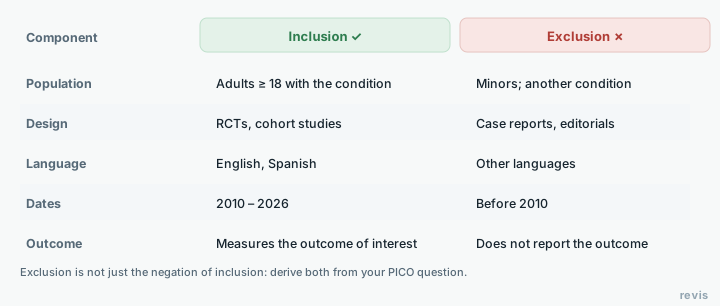
- It helps define the inclusion and exclusion criteria. Population, intervention and comparison usually drive eligibility. Outcomes are set in advance to prevent self-serving decisions later, but a study normally does not have to report them to be included.
That is why the PICO strategy should not be treated as a box-ticking exercise. It is the methodological decision that shapes everything that follows.
The four components of PICO
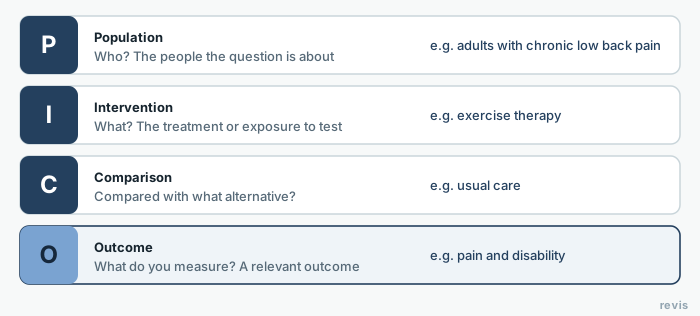
The PICO format has four elements. Define each one precisely, because each plays a different role in the review.
P, population or problem
The P describes who the question is about: the group of patients or people, or the clinical problem of interest. This is where you state characteristics such as age, sex, diagnosis, severity, comorbidities or care setting. Be specific without being so narrow that no literature is left to review. Two examples are "adults over 65 with type 2 diabetes" and "hospitalized patients at risk of pressure ulcers".
I, intervention
The I is the deliberate action you want to evaluate. It can be a treatment, a preventive technique, an educational program or a way of delivering care. Describe it in enough detail to recognize it in the studies, for example by dose, duration or format.
An observed exposure, such as smoking or air pollution, usually fits better in PECO or PEO. A formal diagnostic test accuracy review needs to separate the index test from the reference standard, as PIRD does. You can adapt PICO to those cases, but that does not turn an exposure into an intervention or a reference standard into a therapeutic comparator.
C, comparison
The C is the alternative the intervention is compared with: placebo, usual care, another intervention or no intervention. Not every question has an explicit comparison (prevalence or experience questions, for example, usually do without one), but in treatment questions it is key. Two possible comparators are "standard care" and "usual drug treatment".
O, outcome
The O is the outcome you want to measure. It can be clinical, functional or about safety. Prioritize what matters to patients and clinicians, not only what is easiest to measure. Two examples are a reduction in depressive symptoms on a validated scale and new pressure ulcers at 30 days.
Setting an outcome in advance does not mean excluding a study just because the article does not report it. Cochrane recommends including studies based on characteristics that can be known without looking at their results. Requiring them to report a specific outcome can introduce selective reporting bias.
| Component | Guiding question | Example |
|---|---|---|
| P - Population / problem | Who is affected? What is the problem? | Adults with mild to moderate depression |
| I - Intervention | Which intervention am I evaluating? | Supervised aerobic exercise |
| C - Comparison | Compared with what? | Usual drug treatment |
| O - Outcome | Which outcome do I want to measure? | Reduction in depressive symptoms |
How to write your PICO question step by step
Going from a vague idea to a structured question is an orderly process. These are the steps to apply the PICO strategy without getting lost.
-
Confirm that you are looking for the effect of an intervention. Start from a real question and decide what answer you need. If you are after frequency, experiences, scope, exposure or diagnostic accuracy, look at another framework before filling in PICO.
-
Define the population (P). Describe precisely who is affected: age, sex, diagnosis, setting and any relevant characteristic. If you narrow it too much there will be no evidence left to review; if you leave it too open, the question loses its focus.
-
Specify the intervention (I). Pin down the treatment, program or practice you want to evaluate. The clearer it is, the easier it will be to recognize it in the studies and to build the search.
-
Set the comparison (C). State what it is compared with: placebo, usual care, another intervention or nothing. If your question does not need a comparison, say so explicitly to justify its absence.
-
Decide on the outcome (O). Define a clinically relevant measure and state how it will be assessed, by scale, indicator or time point, where possible.
-
Write the question and check its limits. Join the four components in one clear sentence. Check whether the comparison answers the clinical decision and whether each detail can be applied in the protocol. Do not demand that the whole question fit literally into a single search string.
You can write it with this template: In [Population], what is the effect of [Intervention] compared with [Comparison] on [Outcome]?
That template helps you think the question through. For the manuscript, switch to the declarative form published reviews use ("To assess the effect of..."), because that is what nearly all of them do. In an analysis of how 2,368 published reviews state their question, only 0.7% of Cochrane objectives contained a question mark.
Write your intervention question in revisia. The tool suggests a PICO and flags possible gaps. It can be wrong. You review every field before saving it, and the suggestion does not replace the methodological decisions in your protocol. Try my question for free.
PICO question examples (nursing, medicine, psychology)
Seeing the model applied in different fields helps you absorb it. These are plausible PICO question examples (they do not refer to specific studies; they only illustrate the format).
PICO in nursing
PICO is used a lot in nursing, both in undergraduate theses and in evidence-based practice. An example:
- P. Hospitalized adult patients at risk of pressure ulcers
- I. Repositioning every two hours
- C. Repositioning according to the facility's usual protocol
- O. Incidence of pressure ulcers at 14 days
Question. In hospitalized adult patients at risk of pressure ulcers, does repositioning every two hours, compared with the facility's usual protocol, reduce the incidence of pressure ulcers at 14 days?
Medicine
An example from clinical medicine:
- P. Adults with newly diagnosed mild hypertension
- I. Structured dietary intervention (low-sodium diet)
- C. General dietary advice
- O. Reduction in systolic blood pressure at 3 months
Question. In adults with newly diagnosed mild hypertension, does a structured dietary intervention, compared with general dietary advice, lower systolic blood pressure more at 3 months?
Psychology
In psychological research, the comparison is sometimes another active therapy:
- P. Adolescents with generalized anxiety
- I. Cognitive behavioral therapy
- C. Waiting list
- O. Reduction in anxiety symptoms measured with a validated scale
Question. In adolescents with generalized anxiety, does cognitive behavioral therapy, compared with a waiting list, reduce anxiety symptoms at six months?
If you want more PICO question examples, look at the common pattern. The intervention and the comparison isolate one decision. The outcome is defined before seeing the results, but it is not used by default to exclude studies.
Other frameworks besides PICO
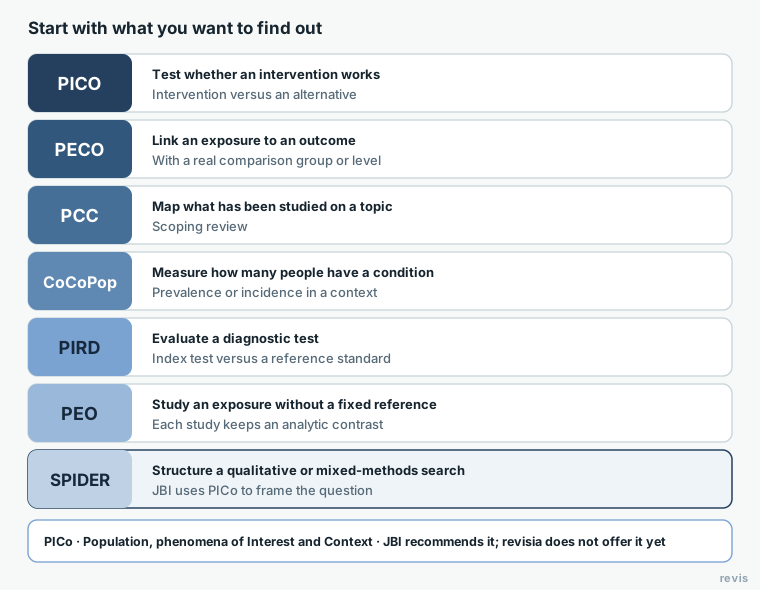
PICO is not the universal framework. Depending on the type of question, you may need to add components or choose a different structure. If you do not know yet which one fits, start by comparing the frameworks available in revisia and their limits.
-
PICOS. Adds an S for study design. It is a common variant in systematic reviews because it makes visible which designs can be included. The design must be defined in the criteria even if it does not appear in the acronym of the objective.
-
PICOT. Adds a T for time, the follow-up period. It is useful when the time point at which the outcome is measured is decisive, as in long-term effectiveness studies.
-
PECO. Replaces the I (intervention) with an E for exposure. It is used in epidemiology and etiology studies, where there is no deliberate intervention but an exposure, such as smoking or air pollution. PEO is the variant without an explicit comparison, and choosing between the two depends on whether your question needs a defined contrast.
-
PICo. JBI uses Population, phenomenon of Interest and Context to frame qualitative synthesis questions. revisia does not yet offer a PICo template.
-
SPIDER. It was created as an alternative tool for turning qualitative and mixed-methods questions into search concepts. It can also organize criteria through Sample, Phenomenon of Interest, Design, Evaluation and Research type. Its five blocks can reduce search sensitivity, so check it against known studies before relying on it.
-
PCC. Organizes Population, Concept and Context for a scoping review question.
-
CoCoPop. Separates Condition, Context and Population in prevalence and incidence questions.
-
PIRD. Distinguishes Population, Index test, Reference test and Diagnosis of interest in a diagnostic test accuracy question.
There are more frameworks, such as PICOTS for prognosis and ECLIPSE for health services management. Choose by the type of answer you need and the methods guidance for your review, not by the acronym you know best.
A PICO can exist at three levels
The Cochrane Handbook separates decisions that often get mixed up.
- The review PICO sets the overall scope.
- Each synthesis can use a more specific PICO, for example for one outcome or one follow-up time point.
- Each included study has its own PICO and may contribute data to some syntheses but not to others.
This separation keeps you from forcing the whole review into a single comparison. A study can meet the general criteria and still report no usable data for a particular meta-analysis. That does not make it an excluded study.
From the PICO question to the search strategy
Once the question is settled, the search begins. The PICO elements supply candidate concepts, but not all of them should appear as required blocks.
The procedure is straightforward:
- Start with the main concepts, usually population and intervention.
- For each one, list free-text terms, synonyms and controlled vocabulary such as MeSH or DeCS.
- Join the synonyms of one concept with OR and the different concepts with AND.
- Add comparison or outcome only after checking that known relevant studies do not drop out.
- Ask an information specialist for a PRESS peer review if the search will support a review you plan to publish.
The Cochrane Handbook advises against routinely searching for all outcomes. They may be missing from the title and abstract or be described in unpredictable words. The PRESS guideline lets you have the strategy reviewed before you run it for good.
Turning the question into a reproducible search is the next step in the process. To go deeper, read our guide on how to build a literature search strategy with Boolean operators, MeSH and DeCS, which walks from the PICO to the final search string.
The PICO question is one of the core stages of a systematic review. To see how it fits into the whole process, from the protocol to the PRISMA-compliant report, go back to the guide on what a systematic review is and how to do one step by step.
revisia suggests a framework and flags possible gaps. It can be wrong. You review every field before saving it and decide which elements to use in the search. Check my question for free.
Frequently asked questions
What is PECO?
It is a framework for exposure questions rather than intervention questions. It covers Population, Exposure, Comparator and Outcome and is used in epidemiology when there is a defined contrast.
Does PICO work for qualitative questions?
PICO is not usually the first choice for a qualitative synthesis. JBI recommends PICo: population, phenomenon of interest and context. SPIDER can help organize the search and eligibility, but its five blocks can reduce sensitivity.
Is the comparison always required?
Not always. Some intervention questions have no active comparator, and other review types use different frameworks. Do not delete the comparison from PICO to make a prevalence, experience or scoping question fit.
What does PICO stand for?
PICO stands for Population, Intervention, Comparison and Outcome. It structures questions about the effects of an intervention compared with an alternative.
What is a PICO question used for?
It turns a question about interventions into a clear research question. It helps define the scope, the comparisons and the outcomes. It does not force you to search for all four elements, and it does not turn every outcome into an inclusion criterion.
What is the difference between PICO and PICOS?
PICOS adds S for study design. While PICO describes population, intervention, comparison and outcome, PICOS makes visible which designs will be accepted. It is a common variant, but the design can also be set in the eligibility criteria without adding the letter to the objective.
How do I go from PICO to the search?
Usually start with population and intervention. Combine the synonyms of each concept with OR and the different concepts with AND. Add comparison or outcome only if tests against known studies show you do not lose sensitivity.
Methods sources checked in September 2026.