Method / Question
Inclusion and exclusion criteria: how to define them
What inclusion and exclusion criteria are in research, how to derive them from PICO, and examples by discipline for your systematic review, ready to adapt.
Inclusion and exclusion criteria are the explicit rules that decide which studies get into your systematic review and which are left out. Together they are called eligibility criteria. They set the "border" of your review before you start searching, so that study selection is reproducible and does not depend on the researcher's on-the-spot judgment. Inclusion criteria describe the features a study must have to be considered; exclusion criteria describe the specific reasons that rule it out even though, at first sight, it fits. Built well, they follow almost point by point from the framework that matches your question, such as PICO for an intervention, and they are then documented according to PRISMA. This guide walks through that process with examples by discipline.
This article is part of our guide on how to do a systematic review step by step.
What eligibility criteria are
Eligibility criteria are the set of predefined conditions that decide whether a study is admissible in your review. You write them in the protocol, before running the search, and they are one of the features that set a systematic review apart from a narrative one. Any reader should be able to take your list of criteria, apply it to the same search results and reach the same selection of studies.
Defining these criteria well does three jobs. First, it sets the scope by turning a broad question ("does exercise work for depression?") into a workable one with clear limits, and in doing so it governs how many studies the review will end up including. Second, it guarantees reproducibility because it prevents "eyeballed" decisions during screening. Finally, it controls selector bias. Two reviewers applying the same rules should agree on almost every decision, and disagreements are resolved by checking the study against the criterion, not against an opinion.
"Eligibility criteria" is the umbrella term. Under it sit the inclusion criteria and the exclusion criteria, which are neither redundant nor mirror images of each other.
Inclusion vs exclusion criteria (they are not the same)
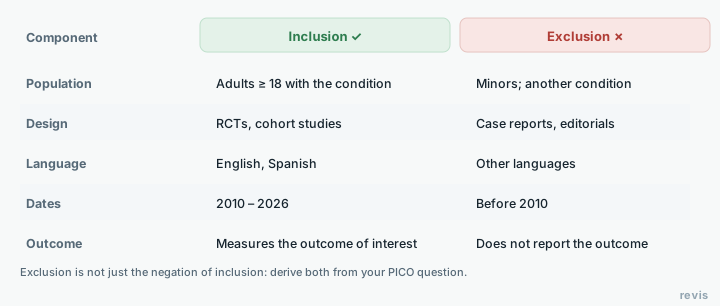
It is tempting to think of exclusion as just "the opposite" of inclusion. It is not, and mixing them up is one of the most common mistakes.
Inclusion criteria define the universe of studies you care about: the population, intervention, comparator, outcome and design that would answer your question. They are positive statements that describe the ideal study.
Exclusion criteria are not the automatic negation of the inclusion criteria. They are specific reasons to drop a study that does meet the inclusion criteria but has a problem that makes it unsuitable. For example, a record that meets population, intervention and design but only exists as a conference abstract; a valid trial that has been retracted; or a study with a comorbidity that would distort the effect.
The practical test to avoid duplicated work is simple. If something is already out because it fails an inclusion criterion, you do not need to turn it into an exclusion criterion. If your inclusion requires "adults aged 18 or over", you do not need an exclusion criterion saying "under 18", because they are already out. An exclusion criterion is only justified when it adds a new reason that inclusion does not capture. This rule prevents bloated, contradictory lists, and it is what peer reviewers expect.
| Criterion | Inclusion (what you are looking for) | Exclusion (what you drop even though it fits) |
|---|---|---|
| Population | Adults (≥18 years) with type 2 diabetes | Patients with type 2 diabetes and end-stage renal disease (a comorbidity that changes the outcome) |
| Intervention | Supervised aerobic exercise program | Interventions that combine exercise with drugs where the effect cannot be isolated |
| Comparison | Usual care or waiting list | No comparison group (single-arm studies) |
| Outcome | Glycated hemoglobin (HbA1c) measured | Studies that only report adherence, with no clinical outcome |
| Study design | Randomized controlled trials | Protocols, editorials, letters to the editor, conference abstracts |
| Language | English and Spanish | Languages with no option for a reliable full-text translation |
| Date | Published from 2010 onward | (not applicable: already ruled out by inclusion) |
Look at the last row. When inclusion already sets the border, the exclusion cell is left empty on purpose. That is correct, not an oversight.
How to derive them from PICO
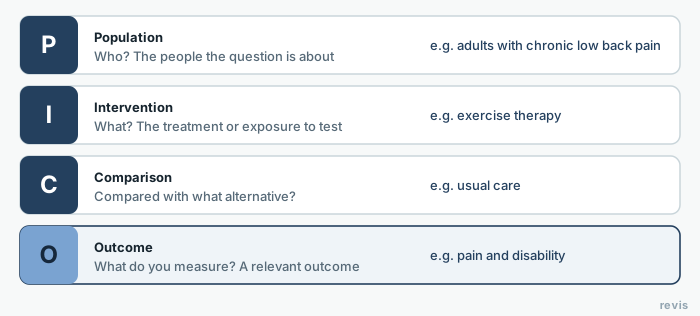
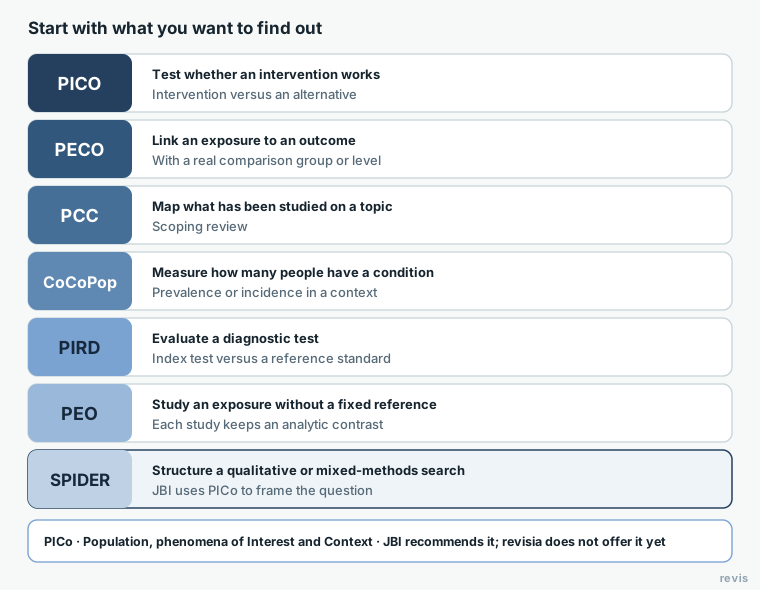
The rigorous way to build your criteria is not to invent them but to derive them directly from your research question. If you framed your question with PICO (Population, Intervention, Comparison, Outcome), each component translates almost literally into a block of inclusion criteria.
To understand where each element comes from, first review how to frame your PICO question. If your question falls short here, your criteria suffer. When we looked at how 2,368 published reviews write theirs, the ones that ended up retracted almost always fall short on the population (80% do not name it), which is exactly the first cell of this table. From there, the mapping is direct:
- Population (P) defines the population criterion: age, sex, clinical or social condition, setting (hospital, community, school).
- Intervention (I) defines which exposure or treatment the study must have examined, with its dose, format or duration if relevant.
- Comparison (C) defines which control group you require (placebo, usual care, another intervention) or whether you accept studies without a comparator.
- Outcome (O) defines which outcomes the study must measure to be useful for your question, and how they must be measured.
To these four blocks you almost always add the study design, the "S" in variants such as PICOS, which classic PICO does not include. For practical reasons you also add limits on language, dates and publication type. The golden rule is that no criterion should be foreign to your question. If you cannot justify it by pointing to PICO or to an explicit methodological reason, you are probably introducing an arbitrary bias.
Common criteria (design, population, language, dates)
Beyond PICO, there is a group of criteria that appear in almost every review. You should know them and, above all, justify them:
- Study design. This is the most decisive methodological filter. A review of a treatment's efficacy is usually restricted to randomized controlled trials; one on prevalence or risk factors will accept observational studies (cohort, case-control). Ruling out editorials, letters, protocols and conference abstracts in advance is common and reasonable.
- Population. Set limits on age, sex, condition and context. Watch out for criteria that are too narrow. The more restrictive the population, the fewer studies you will find and the less your conclusions will generalize.
- Language. Limiting a review to English and Spanish for resource reasons is common, but it is not neutral. It introduces a possible language bias (positive results tend to be published in English). If you apply it, state it as a limitation, not as a harmless choice.
- Publication dates. A time limit is justified when a relevant change (a new guideline, a technology, a diagnostic definition) makes earlier studies irrelevant. Writing "from 2010" for no reason is arbitrary; writing "from the new 2013 diagnostic criteria" has a basis.
- Full text and publication type. It is legitimate to require an available full text and, depending on the case, peer-reviewed literature. If you exclude gray literature, accept that you may reinforce publication bias.
Every criterion should be able to answer "why is this here?". If the answer is "just because" or "to have less work", revise it.
Define your criteria once and in revisia screening applies them consistently, record by record. Create your free account.
Inclusion and exclusion criteria examples by discipline
The same principles take different shapes in each field. These examples are realistic and meant as a guide.
Nursing (wound care).
- Inclusion. Hospitalized adults with pressure ulcers; foam dressings vs standard dressings; time-to-healing outcome; randomized trials; English or Spanish; from 2012.
- Exclusion. Venous or diabetic ulcers (a different population even though they are wounds), and studies where the dressing is combined with negative pressure therapy and the effect cannot be isolated.
Medicine (cardiology).
- Inclusion. Adults with heart failure with reduced ejection fraction; SGLT2 inhibitors; placebo or usual care comparator; hospitalization outcome; randomized trials.
- Exclusion. Retracted trials, post hoc analyses of subgroups that were not prespecified, and studies whose only outcome is biochemical with no clinical endpoint.
Psychology (digital interventions).
- Inclusion. Adults with depressive symptoms (validated scale); internet-delivered cognitive behavioral therapy; waiting-list or active control comparator; post-treatment depression severity; controlled trials.
- Exclusion. Samples with bipolar disorder or psychosis (a comorbidity that changes management), and studies with no standardized outcome measure.
In all three cases, the exclusions add new reasons (comorbidity, no clinical outcome, retraction), not a mere negation of inclusion.
How to document them for PRISMA
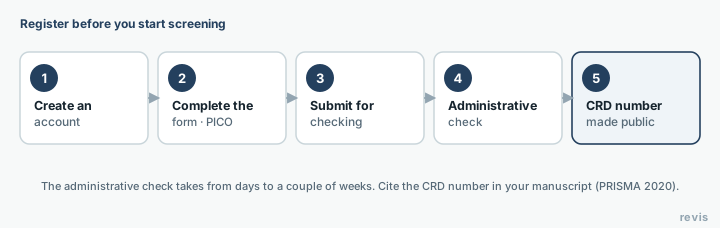
Defining the criteria is not enough. You need to leave a trail of them in two places. First, in the protocol (ideally registered in PROSPERO), where they are published before the review is carried out so they cannot be adapted "as convenient". Second, in the final report, following the PRISMA statement.
PRISMA 2020 asks you to show eligibility in two places. In Methods, item 5 (eligibility criteria) asks you to "Specify the inclusion and exclusion criteria for the review and how studies were grouped for the syntheses" (the cleanest way is to structure them by PICOS). And in the PRISMA flow diagram, at the full-text screening stage, you must record how many reports you excluded and why, in the "Reports excluded" box, grouping the exclusions by the category they triggered (wrong population, ineligible design, missing outcome, and so on).
That is why it pays to give each exclusion criterion a short label from the start. It lets you count exclusions by category without going back through every article. To see how this fits into the visual layout, check our guide to the PRISMA flow diagram and its template. If someone reads your Methods and your diagram, they should be able to reconstruct why each excluded study was left out; if they cannot, your criteria are not properly documented.
In revisia you apply your inclusion and exclusion criteria traceably during screening. Create your free account.
Frequently asked questions
When do you apply the inclusion and exclusion criteria?
During study screening. First on title and abstract, then on the full text, always against the same criteria defined in advance.
Can I change the criteria halfway through the review?
Try to avoid it. If a justified adjustment is needed, document it and update the protocol to stay transparent.
How many criteria should I set?
As many as you need to define your question clearly. Not so few that screening becomes ambiguous, and not so many that you exclude relevant evidence.
What are inclusion and exclusion criteria?
They are the explicit rules that decide which studies get into a systematic review and which are left out. Together they are called eligibility criteria. Inclusion criteria describe the features a study must have (population, intervention, comparator, outcome and design); exclusion criteria give specific reasons to drop a study that fits but has a problem that makes it unsuitable. They are set before the search, and they are what makes study selection reproducible.
How do you define inclusion and exclusion criteria?
You derive them from the research question. If you framed it with PICO, each component (Population, Intervention, Comparison, Outcome) becomes a block of inclusion criteria, to which you add the study design and practical limits on language, dates and publication type. Exclusion criteria are only added when they bring a reason that inclusion does not capture. The key rule is that a criterion does not belong if you cannot explain why it is there.
Can language be a criterion?
Yes. Limiting a review to English and Spanish for resource reasons is common, but it is not neutral. It can introduce language bias, because studies with positive results tend to be published in English. If you apply it, state it explicitly as a limitation of your review and, if possible, justify it (for example, by the team's translation capacity).
Where do you report the inclusion and exclusion criteria?
They are documented in two places. Before you start, in the protocol (ideally registered in PROSPERO), and afterward, in the final report following PRISMA. The Methods section describes inclusion and exclusion by component, and the PRISMA flow diagram records the full-text exclusions grouped by reason. Labeling each exclusion criterion from the start makes that count easy.