Method / Protocol
PROSPERO registration: what it is and how to register your protocol
PROSPERO registration step by step: what PROSPERO is and how to register your systematic review protocol. Requirements, form fields, timelines and alternatives.
Before you start screening studies, you should write down what you are going to do and register it. PROSPERO is the international register where systematic review protocols are published, and PROSPERO registration is one of the signs of rigor your examiners and peer reviewers will look for. The process is simpler than it looks. You open an account, fill in a form of about 40 fields in English and pass an administrative check. And if your review falls outside its remit, there are other places to register.
What PROSPERO is
PROSPERO (International Prospective Register of Systematic Reviews) is a free public register, run by the Centre for Reviews and Dissemination at the University of York and funded by the NIHR, the UK's National Institute for Health and Care Research. Teams publish the protocol of their systematic review there before carrying it out. You declare your question, criteria and methods in advance, so anyone can check later that you did not change the rules halfway through.
It accepts systematic reviews relevant to health and wellbeing (including nursing, physiotherapy, public health and clinical psychology). Scoping reviews and literature reviews are not accepted in PROSPERO, and purely methodological reviews do not always fit. For those cases there are alternatives (see below).
Why register the protocol (and when)
Registering the protocol gives you three things:
- Transparency and bias control. By fixing the question and the inclusion and exclusion criteria before you see the results, you avoid the bias of adjusting the methods until you get the answer you expected.
- Avoiding duplication. Before you start, you can check whether someone is already doing the same review.
- Proof of rigor. Many journals, and the PRISMA 2020 statement itself, ask for the protocol's registration number.
The time to register is before screening starts (ideally after your test searches, but before you select studies). Registering once you have already extracted data defeats much of the purpose.
How to complete your PROSPERO registration step by step
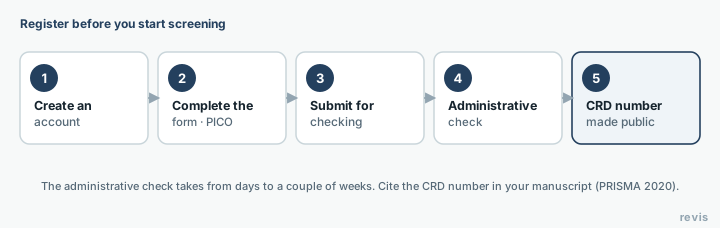
- Create an account on the PROSPERO website (crd.york.ac.uk/prospero) with your email address, preferably your institutional one.
- Start a new registration and complete the form (about 40 fields, many of them optional).
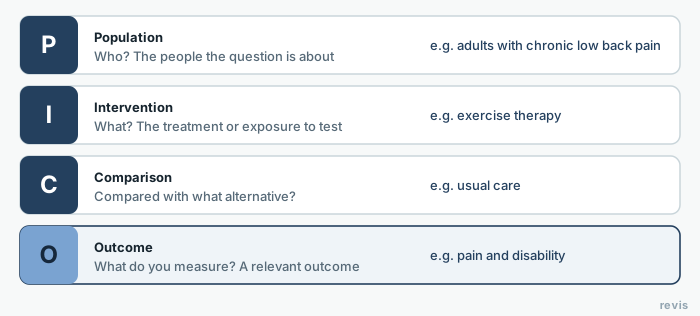
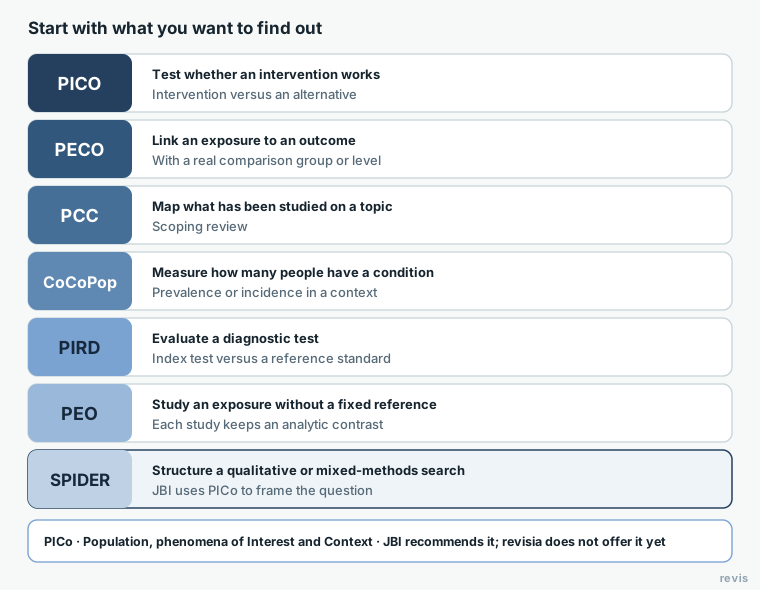
- Define the question using the PICO model: population, intervention/exposure, comparator and outcomes.
- Describe the search. The databases you plan to use and, if you have it, the search strategy with its terms.
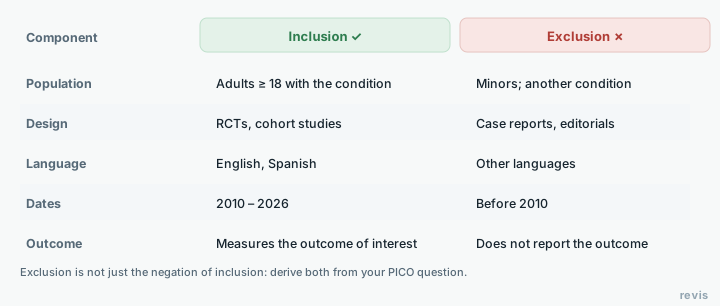
- Set out the methods. Eligibility criteria, screening by two reviewers, data extraction and risk of bias assessment.
- Submit the registration for the administrative check. PROSPERO verifies that it meets the basic requirements (it does not review the scientific quality of the protocol).
What the form asks for
The required fields cover the title, details of the team and the organization, the planned start and end dates, the research question, the eligibility criteria, the information sources, the screening and selection method, and the plan for risk of bias assessment and synthesis. You can save a draft and keep filling it in; there is no need to finish it in one go.
In total the form has about 40 fields, and roughly half are required; the rest can be left blank if they do not apply. Grouped, this is what it will ask you for:
- Identification and team. Review title, contact details, team members with their affiliations and the organization responsible.
- Funding and conflicts. Sources of funding or sponsorship and a declaration of conflicts of interest.
- Question and scope. The condition or health problem studied, population, intervention or exposure, comparator, and primary and secondary outcomes (your PICO, moved over field by field).
- Methods. Planned information sources, eligibility criteria, selection process, data extraction plan, risk of bias assessment and synthesis strategy, stating whether you plan a meta-analysis and which subgroup analyses.
- Project status. The stage the review is at when you submit and the planned start and end dates.
A practical note if English is not your first language. PROSPERO works in English. Both the form and the published record are written in English, so set aside time to translate the protocol accurately (you will already have the terms of your PICO in English from preparing the search).
How long it takes and what happens next
The waiting time varies with the register's workload. At some times the administrative check takes days, and at others it takes several weeks or more. The PROSPERO website itself posts the current estimated time, so submit the protocol with time to spare and do not leave registration until the end. While you wait you can prepare the final searches; what you should not do is start screening before you have submitted the registration. Once accepted, your record gets a public PROSPERO number (of the form CRD42026XXXXXX) that you must cite in the manuscript. The record is not set in stone. You can and should update it if the methods change, and each change is dated, which keeps the audit trail. Keep in mind that this wait is only the first one in the project. Our guide on how long a full systematic review takes gives you the timeline phase by phase.
Your PICO, your criteria and your plan. What you declare in PROSPERO is the first thing you fix in revisia when you create your project, so the methods are locked from day one. Create your free account.
Search for reviews already registered (avoid duplication)
Before registering, search PROSPERO with keywords for your topic. If you find an ongoing review that is very similar, you save months of duplicated work, or you can reshape your question to add something different. It is also a good source for spotting evidence gaps.
Use the search tool on the PROSPERO website (it has a simple search and an advanced search by field). Search in English, the language of the records, combining synonyms for your population and your intervention. Look at the status of each record (ongoing, completed or discontinued) and at its dates. Finding a similar review does not mean you have to give up. Compare its scope with yours (population, comparator, outcomes) and judge whether your proposal offers an update or a different angle.
Alternatives to PROSPERO
If your review does not fit PROSPERO (for example, a scoping review or a methodological review), you have other ways to register the protocol publicly:
- OSF (Open Science Framework). Free, with immediate time-stamped registration; it accepts any type of review (scoping reviews included) and lets you attach materials such as the search strategy.
- INPLASY. A registry specifically for review protocols, with fast publication (paid).
- Publishing the protocol in a journal. Publishing it as an article (for example in BMJ Open or Systematic Reviews) gets it peer reviewed.
Does PROSPERO accept student reviews?
PROSPERO does not set a minimum academic level in its criteria. What it assesses is whether the project is a systematic review within its remit (health and wellbeing) and at an early stage, not who signs it. In fact, records linked to PhD theses and master's dissertations are common. That said, because of the volume of submissions it receives, the register has adjusted its acceptance conditions in recent years. Check the current criteria on its website before submitting and, if you are a student, ask your supervisor to review the protocol before you send it.
For an undergraduate thesis or a master's dissertation, plan for two things. First, timelines. If the administrative check will not come back in time for your academic calendar, you can register the protocol on OSF (it is immediate) and cite that registration in your dissertation. Second, language. The form and the published record are in English. And if your review is the core of the project, our guide on the literature review in a dissertation explains how to fit it into the write-up.
Once the protocol is registered, you run the full review in revisia. Create your free account and get started.
Frequently asked questions
How long does PROSPERO take to accept my registration?
It depends on the register's workload. It can take days or several weeks. Check the estimated time posted on the PROSPERO website and submit with time to spare. The check is administrative (basic requirements), not a review of scientific quality.
Can I register a scoping review in PROSPERO?
No. PROSPERO does not accept scoping reviews. To register one, use OSF or another protocol registry.
What is the CRD number?
It is the public identifier PROSPERO assigns to your protocol (CRD followed by digits), and you must cite it in the manuscript.
Is PROSPERO registration mandatory?
It is not a legal requirement, but it is strongly recommended and more and more journals and examiners expect it. PRISMA 2020 asks you to state where the protocol is registered and its registration number.
Is PROSPERO free?
Yes. Creating an account and registering a protocol in PROSPERO is free.
Can I register if I have already started?
PROSPERO accepts registrations up to the point before data extraction starts. If you have already extracted data, registration loses its preventive purpose; be transparent about it in the manuscript.
What happens if I change the methods after registering?
You update the record. Changes are dated, so the audit trail is kept, and it is not considered bad practice as long as it is documented.
Does PROSPERO accept student reviews (undergraduate or master's)?
It does not require a minimum academic level. It accepts the review if it falls within its health remit and is at an early stage. Check the current criteria on its website and, if the timelines do not fit your academic calendar, register the protocol on OSF.
Protocol registration is one more stage of the method. To place it within the whole process, go back to the guide on what a systematic review is and how to do one step by step.