Method / Question
How to write a prevalence question with CoCoPop
A prevalence review tries to estimate how many people have a condition. CoCoPop organizes the question into condition, context and population so that the figure has a clear meaning.
What is the prevalence of iron deficiency anemia in women of reproductive age seen in primary care? The question has a population and a condition, but no intervention. It doesn't compare treatments either. Forcing it into PICO creates two boxes that don't help you answer it.
The CoCoPop framework was designed for prevalence and incidence reviews. Its parts are Condition, Context and Population. The need comes before the acronym. If you want to estimate how often a problem occurs, this framework usually describes the question better.
What CoCoPop is
The JBI Manual proposes CoCoPop to define the inclusion criteria of reviews that assess prevalence and incidence data.
- Condition states which state, disease, characteristic or event you want to measure.
- Context places the estimate in a relevant care, geographic, social or time setting.
- Population defines who could have the condition.
A short template:
To estimate the prevalence of [condition] in [population] within [context].
For incidence you will need to add the period during which new cases are counted, even though time is not part of the acronym.
A complete CoCoPop question example
We will use this question:
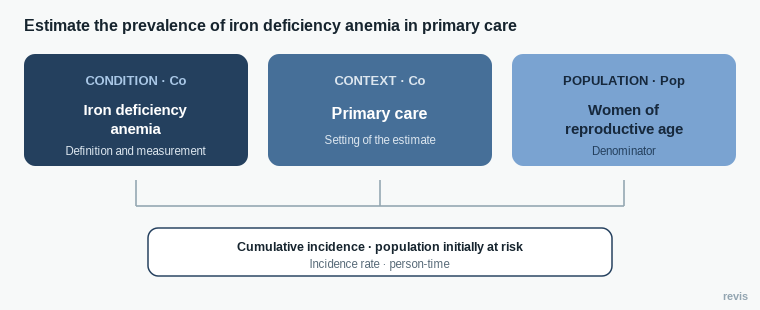
To estimate the prevalence of iron deficiency anemia in women of reproductive age seen in primary care.
| Element | Content | What it controls |
|---|---|---|
| Condition | Iron deficiency anemia | Diagnostic definition and how it is measured |
| Context | Primary care | Setting the estimate comes from |
| Population | Women of reproductive age | People the prevalence will apply to |
Each element changes the denominator or the interpretation. The prevalence among women seen in primary care is not the same as the prevalence among all women in a region. People who attend a clinic may have more symptoms, more risk factors or more diagnostic tests.
Write the question in one sentence. revisia can suggest CoCoPop and flag possible gaps. It can get it wrong. You review the population, the denominator and the time period before saving the question. Split my question into condition, context and population.
Prevalence and incidence do not measure the same thing
Prevalence is the proportion of a population that has a condition at a point in time or over a period. It counts existing cases and needs a denominator that represents the target population.
Incidence describes new cases among people who could develop the condition at the start. It is not a single measure. The CDC distinguishes between an incidence proportion (cumulative incidence) and a rate based on person-time.
| Measure | Numerator | Denominator | Time needed |
|---|---|---|---|
| Point prevalence | Existing cases on a given date | Population assessed on that date | A specific point in time |
| Period prevalence | People who had the condition during the period | Population during the period | Start and end of the period |
| Cumulative incidence | New cases | People initially at risk | Follow-up period |
| Incidence rate | New cases | Sum of each person's time at risk | Person-time |
An incidence question has to state the time and the population at risk:
To estimate the annual incidence of iron deficiency anemia in women of reproductive age seen in primary care.
The period does not become a fourth letter. You add it because a measure of new cases is incomplete without it. The protocol should keep cumulative incidence and incidence rate apart. Their denominators are not interchangeable.
How to define the condition
The condition must be identifiable in a consistent way. Iron deficiency anemia looks specific, but studies may use different hemoglobin and ferritin cut-offs, criteria by age, pregnancy or inflammation, and different laboratory methods.
The protocol must decide which definitions it accepts and how it will analyze their differences. If any definition is allowed, record that variation so you can assess heterogeneity. If you accept only one threshold, justify why and check that you are not removing most of the evidence.
The condition is not a PICO outcome. You are not measuring the effect of something on anemia. You are counting how many people meet the definition.
How to define the context
Context matters when it changes the accessible population, the measurement or the applicability. It can be primary care, hospitals, schools, prisons, a region or a historical period.
In the example, primary care separates a clinic-attending population from a community sample. If the question aims to estimate prevalence in the whole population, limiting it to clinic visits can introduce selection bias.
Don't put every protocol limit into the context. Publication language, full-text availability and study design are separate criteria. Nor should you add a country out of habit if you will accept global estimates and then compare regions.
How to define the population
The population is the denominator of the estimate. It must specify who could appear both with and without the condition.
Women of reproductive age needs a definition of the age range or reproductive criterion. Some studies will use 15 to 49 years, others different limits. Decide whether you will accept each source's definition or apply a common one.
Avoid populations selected because they already have the condition. A sample made up only of people with anemia cannot estimate its prevalence. You should also consider whether high-risk groups, such as patients with kidney disease, belong to the target population or need a separate analysis.
When to use CoCoPop
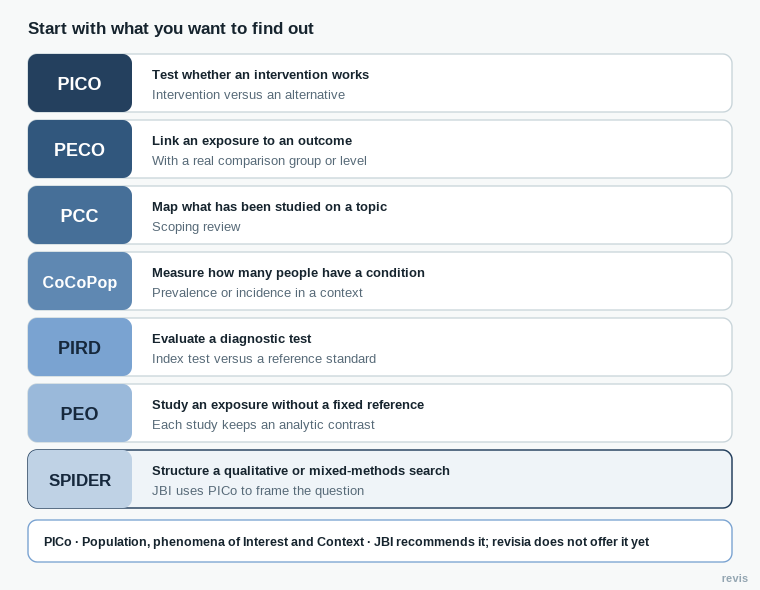
CoCoPop fits when the main answer will be a prevalence proportion, a cumulative incidence or an incidence rate. If you want to study whether an exposure increases risk, use PECO or PEO. If you want to compare the effect of a preventive intervention, use PICO.
These questions start from the same topic and answer different things:
- CoCoPop: what is the prevalence of hypertension in urban populations.
- PECO: how traffic noise is associated with hypertension compared with low-noise areas.
- PICO: whether a noise reduction program lowers blood pressure compared with usual practice.
The framework comparison helps you separate frequency, association and effect before you write the protocol.
From CoCoPop to the criteria
The initial criteria for the example could look like this:
| Element | Eligibility decision |
|---|---|
| Condition | Iron deficiency anemia defined by stated hematological criteria |
| Context | Primary care or equivalent first-level services |
| Population | Women within the reproductive age range defined by the review |
| Prevalence | Numerator and population assessed at the defined point or period |
| Cumulative incidence | New cases, population initially at risk, follow-up and losses |
| Incidence rate | New cases and person-time observed |
Study design matters because not every clinical case series can estimate frequency. A study should describe how it selected the sample, who was at risk, how long it observed the population and, where relevant, how it handled losses to follow-up.
The guide to inclusion and exclusion criteria explains how to document these rules and apply them during screening.
How to take CoCoPop into the search
The condition and the population usually form the main blocks. You can add the context if it appears consistently in titles, abstracts or controlled vocabulary. Test first what happens with studies you already know.
You don't have to search for terms such as prevalence, cross-sectional study or incidence. They can improve precision, and they can also exclude studies that hold useful data without using those labels. The search strategy should be checked with the team and, when possible, with an information specialist.
Common mistakes with CoCoPop
- Forcing an intervention or a comparator. A frequency question doesn't need them.
- Confusing condition and population. The population must include people with and without the condition.
- Using clinical samples to talk about the general population. The context changes the denominator and the applicability.
- Leaving out the period for incidence. New cases need a time window.
- Accepting any definition without recording it. Diagnostic thresholds can explain much of the heterogeneity.
- Mixing denominators. People at baseline, the population assessed and person-time belong to different measures.
Templates for prevalence and incidence
Prevalence
To estimate the prevalence of [condition] in [population] within [context].
Incidence
To estimate the incidence of [condition] during [period] in [population at risk] within [context].
Then turn each element into a criterion you can check, and explain which measure of frequency you will synthesize.
Frequently asked questions
What does CoCoPop stand for?
CoCoPop stands for Condition, Context and Population. JBI proposes it to structure systematic reviews of prevalence and incidence.
What is the difference between prevalence and incidence?
Prevalence measures existing cases in a population at a point in time or over a period. Cumulative incidence divides new cases by the people initially at risk. The incidence rate uses person-time in the denominator.
Does CoCoPop work for incidence?
Yes. JBI uses it for prevalence and incidence. You need to add the time period and state whether you will synthesize cumulative incidence or a person-time rate.
What is the difference between CoCoPop and PICO?
CoCoPop estimates frequency through condition, context and population. PICO compares the effect of an intervention on an outcome.
Is the context required in CoCoPop?
Define it when it changes the selection or interpretation of the estimate. If you will accept any setting, you can state that it is open instead of inventing a restriction.
Methods sources checked in September 2026.
Check the question before you fix the denominator. revisia suggests a framework and flags possible gaps. It can get it wrong. You review the population, the time period and the frequency measure before saving it. Check my prevalence question for free.
A sample made up only of people with anemia cannot estimate its prevalence. CoCoPop separates condition, context and population so the denominator makes sense.
via revisia