Method / Question
How to write a PCC question for a scoping review
PCC helps you frame the question of a scoping review. The hard part is not remembering three letters. It is deciding what belongs to the population, what the concept is, and which context really changes the map of the evidence.
"Telemedicine in palliative care" is a topic. It is not yet a review question. It does not say who is affected, which aspect of telemedicine matters, or in what setting you want to look at it. The PCC framework helps you make those three decisions without inventing an intervention, a comparator or an outcome.
PCC stands for Population, Concept and Context. The JBI Manual recommends it for framing scoping review questions. These questions are usually broader than a PICO question because they aim to map a field, but they can still have precise limits. The design depends on the purpose of the review, not on how many details the sentence contains.
What a PCC question is
A PCC question identifies which evidence you want to locate and describe.
- Population names the relevant people, groups or participants.
- Concept names the phenomenon, practice, intervention, method or issue you want to map.
- Context sets the geographic, social, cultural, institutional or care setting when it changes how the evidence should be read.
The simplest formula is this:
What evidence exists on [concept] in [population] within [context]?
PCC does not require the three parts to appear in those exact words or to be the same length. JBI acknowledges that some reviews can drop an element. The framework is useful because it forces you to decide the scope, not because it gives you three boxes to fill out of habit.
A complete PCC question example
We start from an idea that is still vague:
Telemedicine in palliative care.
We turn it into a scoping question:
To map the evidence on the use of telemedicine for people receiving palliative care in rural areas.
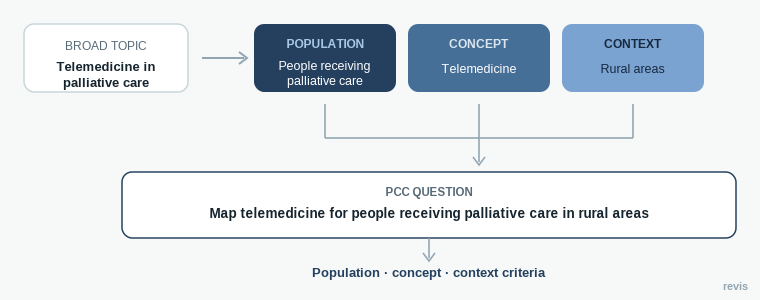
| Element | Content | What it decides |
|---|---|---|
| Population | People receiving palliative care | Who must appear in the source of evidence |
| Concept | Use of telemedicine | Which practice or phenomenon you want to map |
| Context | Rural areas | In which setting it must have been studied |
The final sentence lets you anticipate what the review will produce. You are not trying to calculate whether telemedicine reduces mortality compared with in-person care. You want to describe which uses have been studied, with which populations, methods and results, in rural settings.
Write the topic in your own words. revisia can suggest PCC and split the question into population, concept and context. It can get it wrong. You review every field, and the suggestion doesn't replace the methodological decisions in your protocol. Try my PCC question for free.
How to define the population
The population answers who or what takes part in the evidence. It can be a group of patients, professionals, facilities, organizations or communities. It should include only the characteristics that affect the scope of the review.
In the example, people receiving palliative care sets a clinical population. You could add age, diagnosis or stage of care if the review needs them. Every new detail excludes sources. Before you add one, ask whether it would change the decision to include a study.
A population that is too general, such as patients, returns a field that is hard to interpret. A tight combination of age, disease, prognosis and treatment can leave very few sources. That does not automatically change the design. Check whether those limits serve the purpose of mapping, or whether you are really trying to answer an effect question.
How to define the concept
The concept is the core of the review. Here it is the use of telemedicine. It can cover different modalities, purposes and ways of implementation, but you should state that breadth in the protocol.
JBI explains that the concept can contain elements that other reviews would call the intervention, the phenomenon of interest or the outcome. What matters is defining what counts as evidence of the concept. For telemedicine you will need to decide, for example, whether you include phone calls, remote monitoring, video consultations and asynchronous communication.
The concept should not repeat the population. Palliative care in people with palliative care needs looks complete, but it does not explain what you want to map. Nor should it hide several projects. If you list telemedicine, professional training, caregiver satisfaction and costs as separate concepts, you may need secondary questions or more than one review.
How to define the context
The context places the concept. It can be primary care, hospitals, schools, low-income countries, rural communities or a specific legal system. It only earns its own box when it changes the availability, application or meaning of the evidence.
Rural areas matters in the example because it shapes connectivity, access to services, distances and how care is organized. Articles published in English is not a context. It is a search or eligibility limit that needs its own justification.
You can also leave the context open. If you want to map telemedicine in palliative care in any setting, you don't need to write all contexts just to fill the letter. State in the protocol that you will not apply geographic or care-setting limits.
When to use PCC and when to choose another framework
PCC fits when the goal is to explore the extent, types and characteristics of the evidence. It often goes with questions like these:
- Which concepts or definitions are used.
- Which populations and contexts have been studied.
- Which methods have been applied.
- Which gaps remain for future research.
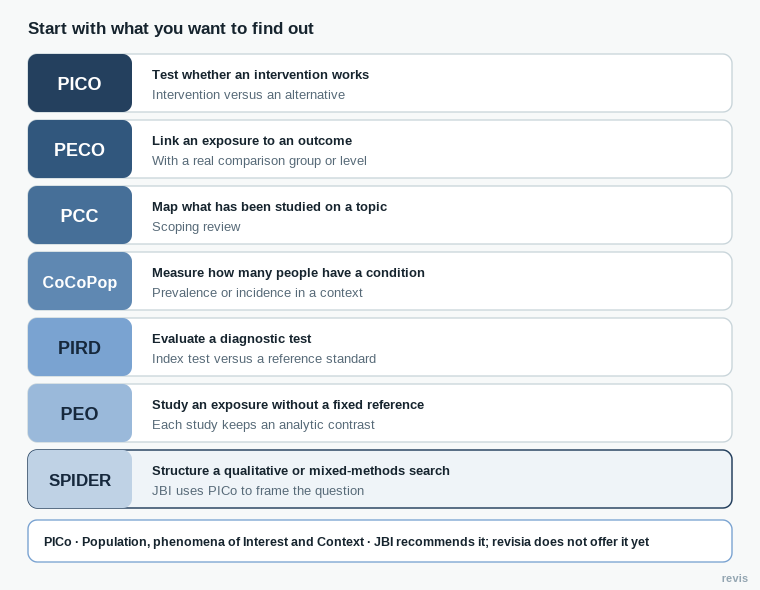
If you want to estimate the effect of one intervention compared with another, use PICO. If you will study the association between an exposure and an outcome, use PECO or PEO. If you are after a prevalence figure, use CoCoPop. You can compare the seven question frameworks before you fix the protocol.
A broad question does not justify a scoping review on its own either. What do we know about telemedicine may simply be an idea that hasn't been worked out yet. You should be able to explain why mapping the field is more useful than answering a narrow question.
From PCC to inclusion criteria
The question and the criteria must tell the same story. JBI's guidance on eligibility recommends developing each PCC element in enough detail for two reviewers to apply it consistently.
| Element | Initial criterion in the example |
|---|---|
| Population | Sources on people receiving palliative care, regardless of diagnosis |
| Concept | Use of remote communication technologies to deliver, support or coordinate care |
| Context | Rural settings as defined by the study or by a classification stated in the review |
To those rules you will need to add the types of sources you will accept. A scoping review can include quantitative, qualitative and mixed methods studies, guidelines, reports and grey literature. Don't assume it must accept any document. Explain which sources help answer the question.
The general guide to inclusion and exclusion criteria helps you turn these definitions into working rules and record reasons for exclusion.
From PCC to the search strategy
PCC organizes the question, but it does not force you to turn the three parts into three blocks joined with AND. The search has to balance breadth and precision.
In the example you would start with terms for palliative care and telemedicine. The rural element can add a third block if it is well described in titles, abstracts and indexing. If relevant studies mention the setting only in the full text, requiring it in the search will make them disappear before screening.
Test several combinations and check whether you retrieve sources you already know. Record synonyms, controlled vocabulary, platforms and dates. Our search strategy guide explains the full process.
Common mistakes with PCC
- Choosing a scoping review because the topic is still vague. First define what you want to map and what the result will be used for.
- Repeating the population inside the concept. Each element should control a different decision.
- Using context as a catch-all. Language, date and design are protocol limits, not default contexts.
- Adding details nobody will apply. If a characteristic changes neither inclusion nor analysis, it doesn't belong in the question.
- Closing the search with all three elements. A poorly indexed context can remove relevant evidence.
Template for writing your PCC question
Fill in these three lines:
- Population I want to study: [who].
- Concept I want to map: [which phenomenon, practice or issue].
- Context that changes the question: [where or in which setting].
Then write one sentence:
To map the evidence on [concept] in [population] within [context].
Check that each element can become a criterion and that the expected result is a map of the field. For the manuscript you can turn the question into a declarative objective.
Frequently asked questions
What does PCC stand for in a scoping review?
PCC stands for Population, Concept and Context. JBI recommends it to structure the question and then align the criteria, search, screening and extraction in a scoping review.
What is the difference between PICO and PCC?
PICO usually estimates the effect of an intervention compared with an alternative. PCC aims to map what evidence exists on a concept in a population and a context.
Are all three PCC elements required?
Not always. JBI acknowledges that some questions can drop an element or need another framework. Each box should do a real job in the scope of the review.
Can the context be a country?
Yes, if the country or region changes the question or the applicability of the findings. Publication language and date are usually protocol limits, not the PCC context.
Do I have to search for population, concept and context?
Not necessarily. The question and the criteria should define the relevant elements. The strategy can leave out a block if it is poorly indexed and cuts sensitivity too much.
Methods sources checked in September 2026.
Check your own question before you search. revisia suggests a framework and flags possible gaps. It can get it wrong. You review every field before saving it. Check my PCC question for free.
In a scoping review, PCC does not force you to combine its three parts with AND. If the context only appears in the full text, requiring it in the search makes studies disappear.
via revisia