Method / By the numbers
How to write a systematic review question
Everyone says a review starts with a good question. Almost nobody shows how the published ones actually write it. We read the objective of 2,368 reviews, from Cochrane to retracted ones, to see what the good ones do and where the rest go wrong.
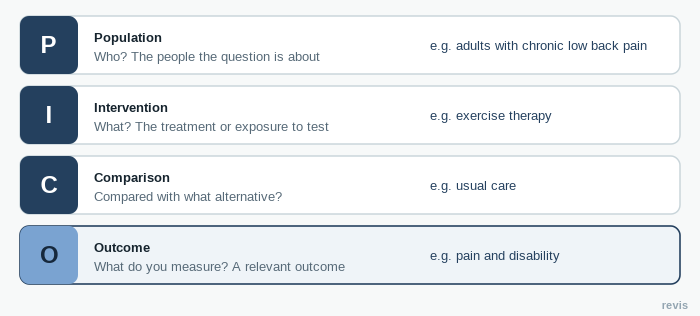
You look up how to write a systematic review question and everyone gives you the same answer. Use PICO. It is good advice, but it only goes halfway. PICO tells you which parts you need. It doesn't tell you how to write the sentence that ends up in the manuscript.
So we went and checked. We collected 2,368 systematic reviews published between 2016 and 2026 and read the objective of each one. Cochrane, top journals, ordinary journals and every retracted systematic review in PubMed. The first surprise came early. Good reviews almost never ask a question. They write a declarative sentence, with no question mark, following a structure so consistent you can copy it.
Below you will find that formula, and also the three flaws shared by the reviews that ended up retracted. If you are writing your question right now, skip to the six checks at the end.
Where these data come from
The corpus is 2,368 systematic reviews from PubMed, enriched with citation data from OpenAlex, split into four groups:
| Group | Reviews | Citation impact (FWCI) |
|---|---|---|
| Cochrane | 600 | 4.11 |
| Top journals | 600 | 5.83 |
| Ordinary journals | 800 | 0.94 |
| Retracted | 368 | 0.79 |
FWCI is citation impact normalised by field and year. A value of 1.0 means "normal for its field". The top two groups are cited well above average. The bottom two, below it. The 368 retracted reviews are all the ones PubMed had flagged as retracted, not a sample.
A word of honesty before going on. To tell whether a review has an objective, a population or a comparator, we looked for patterns in the abstract text. That works very well for comparing groups with each other, which is what we do here, but it doesn't give a perfect absolute figure. Some reviews state their population in the body of the article and not in the abstract, and our count misses them. When you read "80% of retracted reviews don't name their population", take it as "almost none of them put it where you would expect to find it".
Good reviews don't ask, they state an objective
This is the figure that surprised us most. Across the 600 Cochrane reviews, only 0.7% of objectives contain a question mark. In top journals the share is even lower, practically zero.
None of these reviews started without a question. The question existed, in the authors' heads and in the protocol. What happens is that at publication it becomes a commitment. "Does ibuprofen reduce postoperative pain in children?" is a doubt. "To assess the efficacy and safety of ibuprofen for acute postoperative pain in children, compared with placebo or other active comparators" is a contract with the reader. It says what will be done and what it will be compared against.
The difference is not cosmetic. The declarative version forces you to name the comparator and the outcome, because without them the sentence falls apart. The question form lets you off the hook.
In 97.7% of Cochrane reviews you can identify the objective by reading the abstract. Among retracted reviews, only in 58.4%. Four in ten retracted reviews don't say anywhere obvious what they set out to do.
The formula of the best reviews
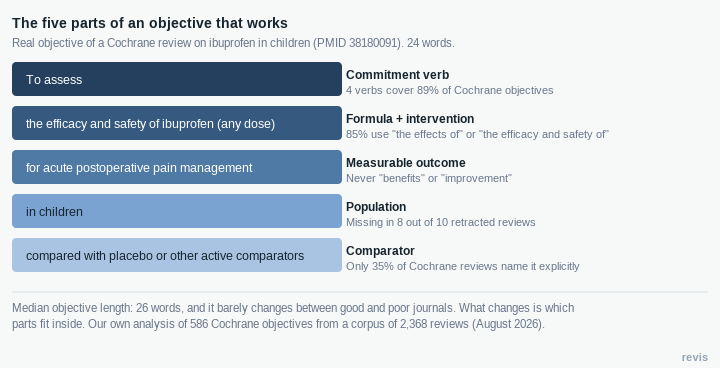
When you line up 586 Cochrane objectives one under another, the repetition is almost comic. 83% start with "To" plus a verb. And four verbs account for 89% of the total:
| Verb | Objectives |
|---|---|
| assess | 285 |
| determine | 109 |
| evaluate | 89 |
| compare | 38 |
After the verb, 85% use one of two formulas: "the effects of" or "the efficacy and safety of". Then come the parts: a specific intervention, comparator, population and outcome.
The median objective is 26 words long. That figure has an interesting twist. The median ranges from 23 to 27 words in all four groups, retracted reviews included. Length doesn't separate good reviews from bad ones. What separates them is what they put inside those 26 words.
Three real examples:
- Ibuprofen for postoperative pain in children (Cochrane, PMID 38180091). "To assess the efficacy and safety of ibuprofen (any dose) for acute postoperative pain management in children compared with placebo or other active comparators." Twenty-four words with all five parts.
- Lamotrigine for refractory partial epilepsy (Cochrane, PMID 27329345). "To determine the effects of lamotrigine on (1) seizures, (2) adverse effect profile, and (3) cognition and quality of life, compared to placebo controls, when used as an add-on treatment for people with refractory partial epilepsy." Here the outcomes are numbered, a device you see a lot in Cochrane when there are more than two.
- Selective digestive decontamination (SDD) in the ICU (JAMA, PMID 36286098). "To determine whether SDD is associated with reduced risk of death in adults receiving mechanical ventilation in intensive care units (ICUs) compared with standard care." Twenty-five words, one hard outcome.
Notice what they don't do. None explains its method, none lists databases, none says "a comprehensive search was conducted". The objective says what you want to find out. The method goes in its own section.
When you create a project in revisia, your question is checked against these same rules before you start searching. This corpus of 2,368 reviews is literally what tuned that check. It can get it wrong, and you review every suggestion before saving it. Create your free account.
The comparator, the detail almost nobody names
Here is a lesson that runs against what is usually taught. Textbooks present the C in PICO as mandatory. In practice, only 35% of Cochrane reviews name an explicit comparator.
This is not carelessness. Many questions simply have no natural comparator. Prevalence reviews don't compare anything. Diagnostic accuracy reviews compare against a reference test, which is something else. Qualitative reviews don't either.
When there is a comparator but it isn't clear which one, Cochrane's house standard is a generic one: "compared with placebo or usual care". That is what the ibuprofen example does with its "placebo or other active comparators". It is honest and doesn't close any doors.
The practical lesson is short. If your question is about a treatment and you don't know what to compare it with, use the generic version. If your question is not about a treatment, don't invent a comparator to fill the box. An invented comparator will later damage your inclusion and exclusion criteria, because it forces you to exclude studies you actually needed.
The three flaws of retracted reviews
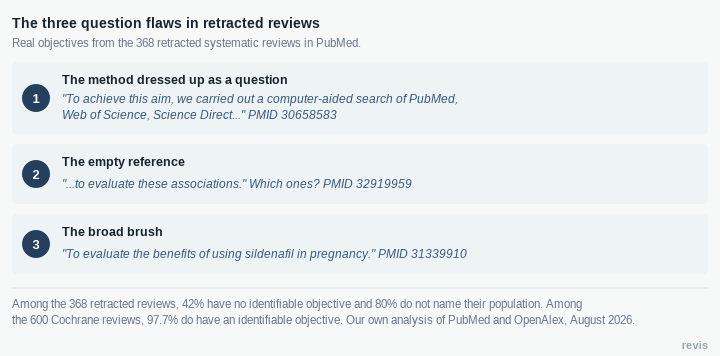
The 368 retracted reviews in PubMed get the question wrong in three recurring ways. All of them are avoidable, and you can spot all three by rereading your own objective.
Flaw 1. The method dressed up as a question
A review on urinary schistosomiasis in school-age children (PMID 30658583, retracted in 2020) explained how it would meet its aim like this: "To achieve this aim, we carried out a computer-aided search of PubMed, Web of Science, Science Direct, African Journals OnLine (AJOL) and the database of World Health Organization."
That is not an objective, it is a method. And the telling detail is what comes next: "However, the information obtained from these sources was supplemented with additional literatures from Mendeley, Research Gate, and Google." A review that describes its search where the objective should be is usually a review whose search was not reproducible. If your objective sentence names a database, delete it and start again.
Flaw 2. The empty reference
A meta-analysis on prenatal exposure to particulate matter and hypospadias (PMID 32919959, retracted) stated: "We conducted this systematic review and meta-analysis to evaluate these associations."
Which associations? The ones in the previous paragraph. The objective doesn't stand on its own. It shows it was written in a hurry, looking backwards, instead of being written first as a commitment. The rule is simple. Your objective must make sense on its own, read in isolation with nothing around it. No "these factors", "this population" or "the above interventions".
Flaw 3. The broad brush
"To evaluate the benefits of using sildenafil in pregnancy" (PMID 31339910, retracted). "In this study, a systematic review and meta-analysis were used to examine the effectiveness of nursing care in the treatment of bladder cancer patients" (PMID 36199769, retracted).
Both sound like research questions, and neither is one. "Benefits" is not a measurable outcome, it is a category. "Nursing care" is not an intervention, it is an entire profession. With objectives like these you can't decide which study goes in and which stays out, and that is where the trouble starts. The nursing care review ended up including five studies with sample sizes ranging from 52 to 131,852 people.
The figures for the retracted group back up the examples. 42% have no identifiable objective and 80% don't name their population. Compared with Cochrane's 97.7% with an objective, the gap is huge.
One more figure worth thinking about. 81% of retracted reviews present themselves as a "meta-analysis" in the title, compared with 48% in ordinary journals. An ambitious label on a weak question is a pattern in itself, and it fits what we found when we looked at why systematic reviews get retracted.
Naming PICO doesn't score points
We counted how many reviews mention the acronym PICO in their abstract, and the result changed our minds. In Cochrane it appears in 0.2%. In retracted reviews, in 2.7%, thirteen times more.
That doesn't mean PICO is useless. It is very useful, which is why we have a full guide to the PICO question with its components, variants and examples. What the data say is that PICO is scaffolding. You use it to build the question and you take it down before you hand in. Reviews that leave it up are often showing that they followed the procedure because the result doesn't speak for itself.
Build PICO into the sentence. Don't recite it.
Six checks for your question
Take your objective exactly as you have written it and run it through this list. Each point comes from one of the figures above.
- Does it start with a commitment verb? Assess, determine, evaluate, compare, estimate. If it starts with "This study aims to analyse the possible relationship between", half of it can go.
- Is the intervention specific and searchable? "Supervised aerobic exercise" is. "Physiotherapy" is a profession, not an intervention.
- Can the outcome be measured? "Reduction in systolic blood pressure at three months" can. "Benefits" and "improvement" can't.
- Is there a comparator, or have you deliberately decided there isn't one? If it is a treatment question and you are unsure, use "compared with placebo or usual care". If it isn't a treatment question, don't fill the box.
- Is the population named? It is the first thing to drop out. Eight in ten retracted reviews don't have it.
- Does it make sense on its own and stay under 30 words? No "these associations", no lists of databases, no methodology.
A before and after, to see it in practice:
Before. Is physiotherapy beneficial for low back pain?
After. To evaluate the efficacy of supervised therapeutic exercise, compared with usual care, on pain intensity and disability in adults with chronic non-specific low back pain.
Twenty-five words. All five parts. And now you can decide which article goes in and which doesn't, which is what a question is for.
Write your question in revisia and we tell you which part is missing before you start screening, with a declarative rewrite ready. It can get it wrong, and you decide what to keep. Create your free account and try it.
Then register it
Once the question is settled, the next step is to write it down somewhere you can't change it when it suits you. That means registering the protocol in PROSPERO.
The corpus data show that this habit has spread fast. In top journals, registration rose from 8% in 2016 to 45-52% in 2025 and 2026. Among retracted reviews it stays at 6.8%, practically the starting level of ten years ago.
Registration records what you were going to ask before you knew the answer, and that is what stops you moving it later. If you want to see where all this fits in the full process, the guide to what a systematic review is walks through the stages in order, and the one on literature search strategy explains how your objective becomes a search string.
Frequently asked questions
Should a systematic review question end with a question mark?
No. Across the 600 Cochrane reviews we analysed, only 0.7% of objectives contain a question mark, and in top journals the share is practically zero. What gets published is a declarative sentence that starts with a verb ("To evaluate the efficacy of..."). The question exists earlier, when you plan the project, but in the manuscript it becomes an objective.
How many words should a review objective have?
The median in our corpus is 26 words, and it ranges from 23 to 27 across all groups. Thirty words is a good ceiling. If you go well over, it is usually because you have put methodology inside the objective. If you come in very short, the comparator or the outcome is almost certainly missing.
Which verb should I use for my review objective?
Four verbs cover 89% of Cochrane objectives: assess, determine, evaluate and compare. Choose according to what you will do: "compare" if you contrast two interventions, "determine" if you are after a specific effect, "evaluate" or "assess" if you look at efficacy and safety together. After the verb, 85% use "the effects of" or "the efficacy and safety of".
What do I write if my question has no comparator?
It depends on the type of question. If it is about a treatment and you have no clear comparator, use the generic one Cochrane uses: "compared with placebo or usual care". If it is a prevalence, qualitative or other question that doesn't compare anything, leave it out. Only 35% of Cochrane reviews name an explicit comparator, so a justified absence is not a flaw. The real problem is inventing one to fill the box, because it shapes your inclusion criteria.
Should I mention PICO in the manuscript?
There is no need, and the data suggest it is better not to. The acronym PICO appears in 0.2% of Cochrane abstracts and in 2.7% of the abstracts of retracted reviews. PICO is the tool you use to build the question, not a label you stick on the result. Use its components inside the sentence and drop the name.
We read the objective of 2,368 systematic reviews. Only 0.7% of Cochrane objectives end with a question mark, and 80% of retracted reviews don't name their population.
via revisia