Method / Question
How to write a diagnostic accuracy question with PIRD
A diagnostic test accuracy review studies how well a test detects a condition. PIRD organizes population, index test, reference and target condition. The protocol adds the clinical role and the threshold where relevant.
An ultrasound scan can help detect appendicitis. It can also change the time to surgery. Those are two different questions. The first measures diagnostic accuracy. The second studies the effect of using the test on care.
The PIRD framework is for the first one. Its parts are Population, Index test, Reference test and Diagnosis of interest. In diagnostic methodology, target condition is the more precise term. The framework makes you state which test you want to evaluate, what you will use to know the true state of the condition and what you are trying to detect.
What a PIRD question is
Diagnostic test accuracy reviews synthesize how well a test correctly classifies people with and without a condition. The methodological typology of reviews recommends PIRD for framing these questions.
- Population identifies the people in whom the test would be used.
- Index test is the technique, instrument, rule or biomarker you want to evaluate.
- Reference test is the method used to establish whether the condition is present.
- Diagnosis of interest is the target condition the test tries to detect or rule out.
A useful template:
Determine the accuracy of [index test] compared with [reference] for detecting [target condition] in [population], with [clinical role and threshold] where relevant.
A complete PIRD question example
We will use a question in which the whole sample can receive the reference:
Determine the accuracy of a rapid antigen test, used for triage, compared with laboratory RT-PCR for detecting influenza in adults with acute respiratory symptoms.
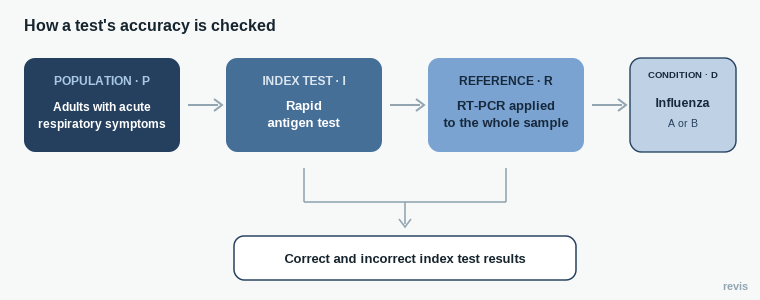
| Part | Content | Check question |
|---|---|---|
| Population | Adults with acute respiratory symptoms | Who would receive the test |
| Index test | Rapid antigen test | Which test you want to evaluate |
| Reference | Laboratory RT-PCR applied to the whole sample | How the state of the condition is established |
| Target condition | Influenza virus infection | Which condition must be detected |
| Clinical role | Triage before confirmation | Which decision it would inform |
The design requires giving the rapid test and the RT-PCR to everyone included, with independent interpretation where possible. If only people who test positive on the rapid test get confirmed, you have partial verification and the estimate can be biased.
Write the question in plain language. revisia can suggest PIRD and split it into its four parts. It can get it wrong. You add the clinical role, the threshold and the reference rules your protocol needs. Separate my index test and my reference.
How to define the population
The population is not people who already have a confirmed diagnosis. It should represent the people who would arrive in practice with a suspected condition and could receive the test.
In the example, they are adults with acute respiratory symptoms. You can add age, care setting, symptom duration or epidemic season if they change how the test performs. A population of very clear cases and healthy controls can produce better figures than a consecutive sample of people with similar symptoms.
The prevalence of the condition and the spectrum of severity also matter. A test can behave differently in primary care, the emergency department and a specialist unit.
What the index test is
The index test is the test whose performance you want to know. It can be a laboratory test, an imaging test, a scale, an algorithm, a clinical examination or a prediction rule.
Describe it in as much detail as could change its results. For an antigen test, the manufacturer, sampling method, days since symptom onset, reader and positivity criterion all matter. If you will accept several versions, explain how you will group or compare them.
A review can evaluate one test or several. If you compare several index tests with each other, state whether you need studies that apply them to the same people or whether you will accept indirect comparisons across different studies.
What the reference test is
The reference sets the state of the condition against which the index test is compared. It is sometimes called the reference standard. Avoid labelling it gold standard by default, because many references are imperfect.
It can be histology, culture, clinical follow-up, expert consensus, another technique or a combination. Explain which versions you accept and whether their errors could misclassify the condition.
Plan for several risks:
- Partial verification, when only part of the population receives the reference.
- Differential verification, when different groups receive different references.
- Incorporation bias, when the index test result is part of the reference itself.
The quality of the review will depend on how you handle those designs. PIRD makes the reference visible from the question onwards, so it does not become a late decision.
What the target condition is
The target condition is what you want to detect. It needs a clear clinical or methodological definition. Respiratory infection is too broad. Influenza A or B virus infection confirmed by RT-PCR lets you define presence and absence.
Do not confuse the condition with an accuracy measure. Sensitivity, specificity, predictive values and likelihood ratios describe how the test performs. They do not replace the target condition in PIRD.
Clinical role, threshold and comparing tests
The same test can play different roles. It can rule out cases as triage, replace a more invasive test or be added to an existing pathway. The Cochrane Handbook for diagnostic test accuracy reviews asks you to state that role because it changes the population, the threshold and the relevant comparison.
If the test produces a continuous value, define the thresholds you will accept or how you will analyse their variation. If you compare two index tests, state whether you need both applied to the same people. Direct within-participant comparisons are usually easier to interpret than comparing results from separate studies.
PIRD vs PICO
Having a medical test in it does not make every question a PIRD question. Compare these two:
PIRD
How accurate is a rapid antigen test compared with RT-PCR for detecting influenza in adults with acute respiratory symptoms?
PICO
In adults with respiratory symptoms, does using a rapid test instead of waiting for RT-PCR reduce the time to isolation or appropriate treatment?
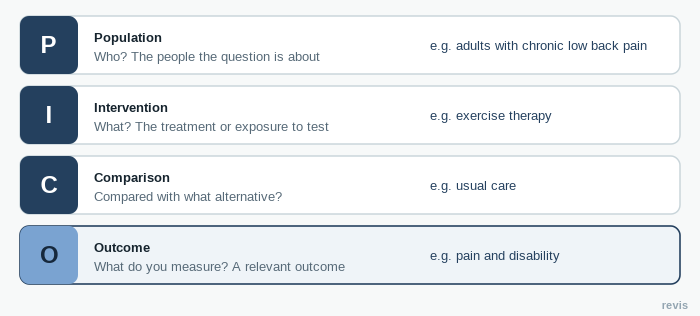
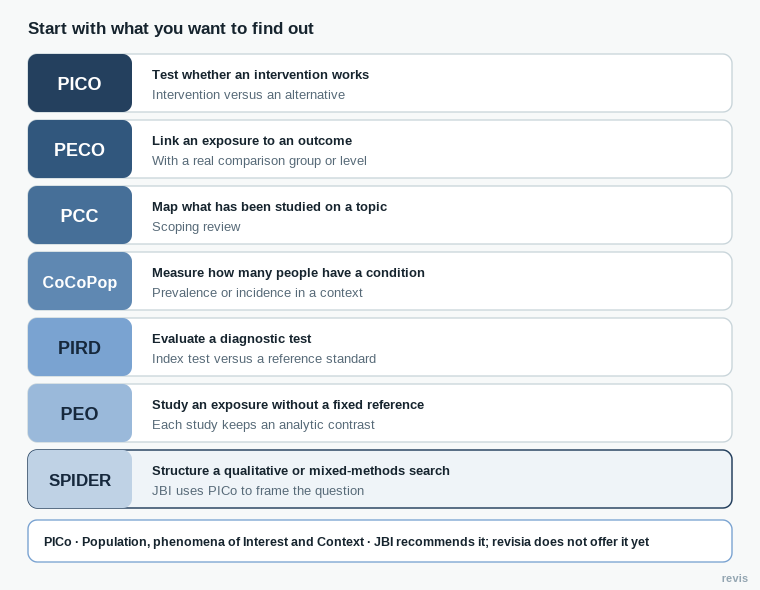
The first question measures diagnostic classification. The second measures the effect of a strategy on a clinical decision or outcome. The designs, measures and criteria change. If you are still unsure, use the comparison of the seven frameworks.
Sensitivity and specificity in the review
Sensitivity is the proportion of people with the condition who get a positive result. Specificity is the proportion of people without the condition who get a negative result.
Both depend on the threshold and the setting. A test can gain sensitivity at the cost of specificity. That is why the question must describe the test, the population and the reference before you choose which estimates to pool.
Predictive values also depend on the prevalence of the condition. They do not transfer directly from a specialist population to a lower-risk one.
From PIRD to inclusion criteria
Initial criteria for the example could be:
| Part | Eligibility decision |
|---|---|
| Population | Adults with acute respiratory symptoms who would receive the test in practice |
| Index test | Rapid antigen test with manufacturer and positivity criterion reported |
| Reference | Laboratory RT-PCR applied to the whole sample and interpreted without knowledge of the rapid test where possible |
| Target condition | Influenza A or B virus infection according to RT-PCR |
| Clinical role | Triage before confirmation or a treatment decision |
| Data | Enough information to rebuild true and false positives and negatives |
You will also need to decide on designs, consecutive or random selection, thresholds, direct comparison between tests and how to handle inconclusive results. The guide to inclusion and exclusion criteria helps turn them into screening rules.
How to start the search
The index test and the condition are usually the core concepts. You can add the population if it brings stable terms without narrowing retrieval too much. The reference rarely appears consistently in titles and abstracts.
Cochrane has evaluated filters designed to retrieve accuracy studies. Its review of diagnostic search filters found variable sensitivity and recommends caution. Requiring words such as sensitivity, specificity or accuracy can miss studies that contain the data without using those labels.
Test the search string against known studies and document every version. The literature search guide explains how to combine synonyms and controlled vocabulary.
Common mistakes with PIRD
- Using an already diagnosed population. The sample should resemble the people who would receive the test in practice.
- Calling any reference a gold standard. Describe its limits and possible errors.
- Applying the reference only to positives. Partial verification can inflate performance.
- Confusing accuracy with clinical benefit. Better detection does not on its own show better outcomes for patients.
- Searching only for accuracy terms. Many relevant studies do not state them in the title or abstract.
- Leaving out the clinical role. A triage test answers a different decision from a replacement or add-on test.
- Ignoring the threshold. Changing the cut-off changes sensitivity and specificity.
- Comparing tests only across different studies. If the question is comparative, define whether you will require a direct comparison in the same participants.
Template for writing your PIRD question
Fill in six lines:
- Population: [who would receive the test].
- Index test: [which technique or instrument you are evaluating].
- Reference: [how the condition is established].
- Target condition: [what you want to detect].
- Clinical role: [triage, replacement or add-on test].
- Threshold: [cut-off or positivity criterion where relevant].
Then write:
Determine the accuracy of [index test] compared with [reference] for detecting [target condition] in [population], with [clinical role and threshold] where relevant.
The JBI Manual chapter on diagnostic test accuracy systematic reviews uses an equivalent structure to keep title, objective, question and criteria aligned.
Frequently asked questions
What does PIRD stand for?
PIRD stands for Population, Index test, Reference test and Diagnosis of interest. Protocols usually call the last part the target condition. It is used to frame diagnostic test accuracy questions.
What is the difference between the index test and the reference?
The index test is the one you want to evaluate. The reference is the method used to establish whether the condition is present and to count the correct and incorrect results of the index test.
What is the difference between PIRD and PICO?
PIRD measures how well a test detects a condition. PICO measures the effect of an intervention or strategy, compared with an alternative, on clinical outcomes.
Is the reference always a gold standard?
No. Many references have errors or combine several sources. The protocol should describe their limits and make sure the reference does not depend on the index test result.
Should I search for sensitivity and specificity?
Not as your only strategy. Adding accuracy terms can miss studies. It is usually safer to combine the index test with the condition and check what the search retrieves.
Methods sources consulted in September 2026.
Check what type of question you have. revisia suggests a framework and flags possible gaps. It can get it wrong. You review the reference, the target condition, the clinical role and the threshold. Try my diagnostic question for free.
If only people who test positive on the rapid test get confirmed by RT-PCR, accuracy can come out inflated. How to write a diagnostic accuracy question with PIRD.
via revisia