Method / By the numbers
Do you need Scopus and Web of Science for your systematic review? What they add over open databases
The Dutch Research Council and France's CNRS have stopped paying for Scopus and Web of Science. They did it mainly for research assessment, not for reviews. Still, the obvious question follows: how much does a systematic review lose if it only searches open databases? We measured it with reviews published in 2025 and 2026.
In October 2026, the Dutch Research Council (NWO) announced that from 1 January 2027 it will stop paying for Web of Science and Scopus. It will use open sources such as OpenAlex and Crossref instead. France's CNRS had already done the same: it dropped Scopus in 2024 and Web of Science in 2026, saving about 1.4 million euros a year on the latter alone. The universities of Utrecht, Groningen and Maastricht, and the Sorbonne, are going the same way.
There is an important nuance. These institutions used those databases mainly to assess research: finding reviewers, counting publications, checking conflicts of interest. Not to do systematic reviews. But anyone doing a review asks the same question. If your university stops paying for Scopus, does your review lose studies?
We measured it.
What we measured
We randomly chose 30 systematic reviews published in 2025 and 2026, on very different topics: artificial intelligence in diagnosis, nursing, psychology, cardiology, environmental health, physiotherapy and traditional Chinese medicine. All 30 searched at least one subscription database: Embase (20 reviews), Web of Science (17), Scopus (12) or Chinese databases such as CNKI and Wanfang (6). Together they include 695 studies.
For each included study, we checked whether it is in the open databases: PubMed, OpenAlex and ClinicalTrials.gov.
Almost everything is in open sources
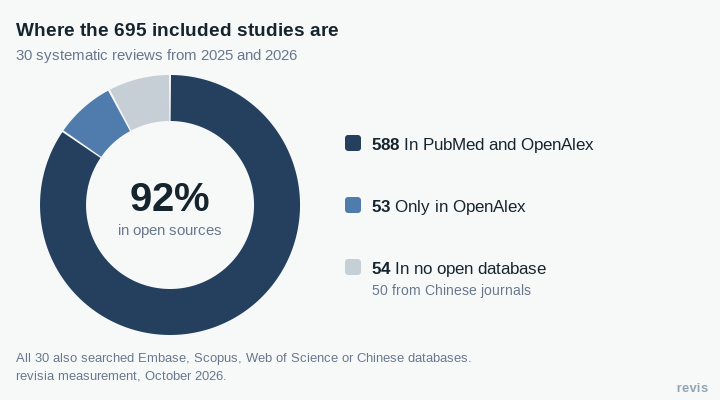
641 of the 695 included studies (92.2%) are in an open database. 21 of the 30 reviews have all their studies in open sources, and 26 have at least 90%.
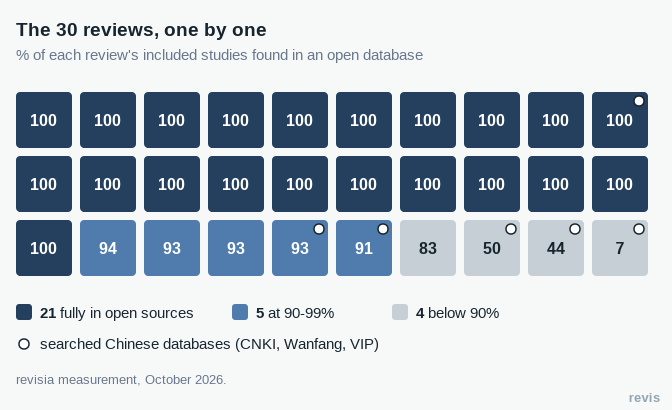
The 54 missing studies have a clear explanation. 50 come from the 6 reviews that searched Chinese databases. They are studies published in Chinese journals that do not appear in any open database and that these reviews found in Chinese databases such as CNKI, Wanfang or VIP. If we set those 6 reviews aside, 519 of 523 studies are in open sources: 99.2%.
In other words, in this sample the subscription databases that actually contributed unique studies were not Scopus or Web of Science. They were the Chinese databases, for the Chinese literature.
OpenAlex already covers more than PubMed
PubMed is still the reference database in the health sciences, and it holds 588 of the 695 studies (84.6%). But OpenAlex, an open and free catalogue of the scientific literature, holds all of those 588 plus 53 more: 92.2%.
Those 53 studies come from journals that PubMed does not index: psychology (Mindfulness, Journal of Research in Personality, Current Psychology), nursing and midwifery (British Journal of Midwifery), engineering (IEEE) and the social sciences. These are exactly the fields where a PubMed-only search falls short.
OpenAlex has improved a lot over the past year. In November 2025 it rebuilt its system from the inside, added about 190 million works (it now has more than 470 million) and now also indexes material that only exists in repositories. In 2026 it recovered about 3 million abstracts that it held but did not display.
What happens with journals
Our sample is small, but it matches much larger studies. In 2025, Maddi and colleagues compared which open access journals each database indexes.
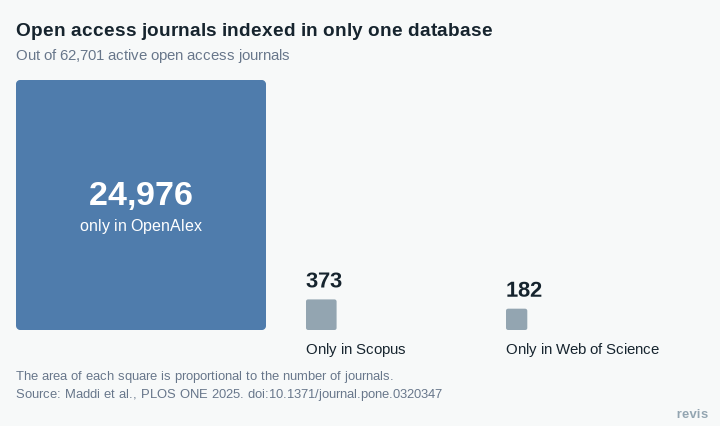
Of 62,701 active open access journals, 24,976 are only in OpenAlex. Only 373 are exclusive to Scopus and 182 to Web of Science. Another 2026 study, still a preprint, found that Scopus and Web of Science overlap by 95%: paying for both adds little over paying for one.
That is what NWO criticises in its announcement. The commercial databases cover the social sciences, the humanities and non-English publications less well.
The limits of OpenAlex
OpenAlex does not solve everything, and it is worth knowing its limits before relying on it alone.
- Abstracts are missing. Only 3 in 4 of the included studies that OpenAlex holds come with their abstract (479 of 641). For title and abstract screening you still need PubMed, which has the abstract for almost everything it indexes.
- Full text is not always free. OpenAlex flags 398 of the 641 studies (62%) as free to read. The rest you have to request from the author or the library.
- Its API is no longer unlimited. Since February 2026 it charges for use above a small daily allowance. The data are still open, under a CC0 licence.
- Chinese literature is left out. As we saw, without CNKI or Wanfang you miss studies published only in Chinese journals.
revisia searches PubMed, Europe PMC, OpenAlex and ClinicalTrials.gov, all four open, and also imports your Scopus or Web of Science files if you have them. Create your free account.
What this analysis does not say
These are 30 reviews chosen at random among those with full text in PubMed Central and a table of included studies we could check. That tilts the sample towards the health sciences. In the humanities, where PubMed barely reaches, OpenAlex matters even more.
Nor does a study being in a database guarantee that your search will find it. That depends on your search strategy.
And we are not saying Embase is unnecessary. The Cochrane Handbook recommends it for many clinical reviews, and for drug questions it often contributes studies of its own.
Our recommendation: start with PubMed and OpenAlex, and add subscription databases only if they add something. If your question touches on Chinese medicine, CNKI or Wanfang do make a difference. If your university pays for Scopus or Embase, use them. If it stops paying, your review will not run out of studies.
If you want to know what each database offers, we explain it in databases for systematic reviews. And on how many reviews can be read for free, see open access in systematic reviews.
Starting a review? In revisia, searching the open databases is included, the AI screens and you verify with the quote alongside. Create your free account.
Frequently asked questions
Can you do a systematic review without Scopus or Web of Science?
In our sample, yes. Across 30 systematic reviews from 2025 and 2026, 92% of the included studies were in open databases, and 99% once Chinese literature is set aside. What gets lost does not come from Scopus or Web of Science but from Chinese databases such as CNKI or Wanfang.
Does OpenAlex replace PubMed?
For finding out what exists, OpenAlex covers more: it had every PubMed study in our sample plus 53 more. For screening, not yet: it lacks the abstract for 1 in 4 studies. The best option is to use both.
What is OpenAlex?
It is an open, free catalogue of the scientific literature, with more than 470 million works from every discipline. It covers many journals that PubMed does not index, especially in psychology, the social sciences and engineering, and from outside the United States and Europe.
Why are NWO and CNRS dropping Scopus and Web of Science?
For cost and for science policy reasons. Both signed the Barcelona Declaration on Open Research Information. NWO also says these databases are incomplete, biased towards English and thin on the social sciences and humanities. They used them mainly for research assessment, not for systematic reviews.
Is Embase unnecessary in a clinical review?
Not necessarily. The Cochrane Handbook recommends it for many clinical reviews. Our advice is to start with the open databases and add Embase if your question needs it and you have access.
In 30 systematic reviews from 2025 and 2026, 92% of the included studies are in OpenAlex and 85% in PubMed. Do you need Scopus and Web of Science?
via revisia