Method / Extraction
Data extraction in a systematic review: table, process and common errors
After screening, each included study has to be turned into usable data, and that conversion decides how reliable every later stage will be. What goes in the data extraction table, how methodological standards say it should be done and the documented errors worth avoiding.
Data extraction in a systematic review is the stage where you turn each included study into structured, comparable information. You record which population it studied, which intervention it tested, with how many participants, what it measured and what results it got. Everything goes into a form designed in advance. It is the raw material for the synthesis and the meta-analysis, and also the quietest stage of the method. Screening gets talked about a lot because it hurts; extraction hardly at all. Yet this is where a review stakes the reliability of its conclusions. They rest either on faithful data or on typos. This guide covers which fields go in the table, the process the standard asks for, how long it really takes and the documented errors that have spoiled the most syntheses.
Where it falls in the method (and why it matters so much)
In the workflow of a systematic review, extraction comes once screening is over and you know which studies are in. Everything that follows is built on what you extract. The risk of bias assessment uses design details that come from here, and the synthesis or meta-analysis combines the numbers you entered. A transcription error at this stage carries through to the pooled effect, the forest plot and the conclusion.
That is why PRISMA 2020 devotes two full items of its checklist to it, items 9 and 10. Item 9 asks you to "specify the methods used to collect data from reports, including how many reviewers collected data from each report, whether they worked independently" and how any disagreements were handled, and item 10 asks which variables you sought, including those that did not appear in every study. If the extraction method cannot be described, the review cannot be reproduced, and we saw in the comparison with the narrative review that reproducibility is exactly what the effort of the systematic method buys.
Which fields to include in the data extraction table
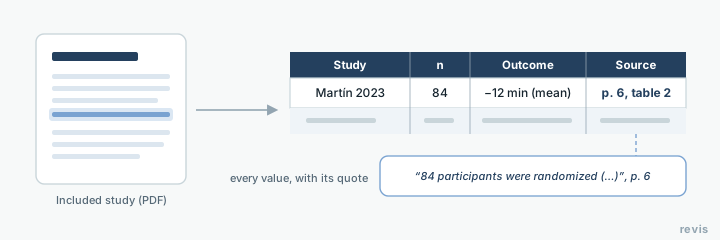
There is no universal data extraction template, because the fields depend on your research question. There is, however, broad agreement on the blocks a data extraction sheet should cover. This table sums them up with examples.
| Block | Typical fields | Example |
|---|---|---|
| Identification | Authors, year, country, journal, funding and conflicts of interest | Martín 2023, Spain, public funding |
| Design and methods | Study type, duration, follow-up, unit of randomization (individual or cluster) | Randomized trial, 12 weeks of follow-up |
| Participants | Sample size, eligibility criteria, age, sex, setting | n = 84, adults with chronic insomnia |
| Intervention and comparator | What was done in each arm, dose, frequency, adherence | Melatonin 2 mg vs placebo |
| Outcomes | Measures used, time points, numerical data per arm | Sleep latency at 8 weeks, mean and SD |
| Notes for risk of bias | Sequence generation, blinding, losses | 12% losses reported per arm |
| Source of each value | Page, table or sentence the value comes from | Mean in table 2, page 6 |
Two tips that save a lot of grief. First, define each field in writing (which format, which units, what to do if the value is missing), because "follow-up" can mean three different things to two extractors. Second, take the last block seriously: the source of each value. When the time comes to check a disagreement, that record turns an afternoon of rereading PDFs into a one-minute check.
The extraction process the standard asks for
Extraction has its rituals, and they are not red tape. The documented errors in the next section are the bill for skipping them.
- Design the form from the protocol. The variables to extract are declared in the protocol before you see the results, just like the inclusion criteria. Choosing what to extract after reading the studies opens the door to cherry-picking results, even unintentionally.
- Pilot it on a few studies. Before you tackle the full corpus, run the form on a handful of varied studies. The pilot exposes ambiguous fields, units that do not fit and data you assumed would be there and are not. Fixing the form after 5 extracted studies is cheap. After 40, it is not.
- Extract outcome data in duplicate. The Cochrane standard requires two independent extractors for outcome data, no shortcuts. For the other fields, such as study characteristics, the acceptable minimum is that one person extracts and another checks against the article. The logic is the same as in paired screening. Individual errors are unavoidable, and cross-checking catches them.
- Record disagreements and how they were resolved. Consensus, a third person or going back to the text. The mechanism does not matter as long as it is written down, because PRISMA will ask you to report it, just as it asks for the numbers in your PRISMA flow diagram.
- Contact the authors when a key value is missing. It is standard practice (PRISMA even asks you to describe how data were confirmed with study investigators), and it shows the gap was not laziness.
If you screen and extract alone, as in many undergraduate theses and master's dissertations, the honest advice is the same as for the rest of the method. State the limitation and offset it where you can, for example by checking your own extraction a few days later, with a blank form, on a sample of studies.
In revisia, extraction comes with verification built in. Every value the AI extracts comes with its verbatim quote from the article next to it, or with a flag if it has none, so confirming a cell takes seconds, not another read of the PDF. Create your free account.
The extraction errors you pay for in the synthesis
The evidence on extraction errors exists, and it is uncomfortable. The classic audit is the one by Gøtzsche and colleagues (JAMA, 2007), who recalculated published meta-analyses by comparing their data with the original articles and found errors in 17 of the 27 they checked. One was retracted after the check. These are the classics:
- Transcription errors. The n = 84 of Martín 2023 becomes 48, the standard deviation is entered as a standard error, or the control group's value ends up in the intervention column. They are the silliest and the most frequent, and duplicate cross-checking exists to catch them.
- Double counting in multi-arm studies. If a trial compares two doses against the same placebo and you put both comparisons into the meta-analysis, the control group counts twice and the study's weight is inflated.
- The same trial, counted twice. A study published in two articles (the interim and the final analysis, or two different journals) can slip into the synthesis as if it were two studies. Compare registration numbers, sample sizes and authors before you accept the list of included studies.
- Mixing adjusted and unadjusted effects. One study reports the crude effect and another the effect adjusted for age and sex. Combining them without an explicit rule adds noise that is hard to detect later.
- Medians where you needed means. Many studies report the median and interquartile range. Converting them to a mean and standard deviation is possible with published formulas, such as those of Wan and colleagues (2014), but you have to declare it and apply it the same way to every study.
- Extracting only the striking result. If the study measured the outcome at three time points and you only enter the favorable one, you have inherited its reporting bias. The form must fix in advance which time point and which measure are extracted.
The reader of the review cannot spot any of these errors. Only a process with a piloted form, duplicate extraction and the source recorded for each value prevents them.
How much extraction costs (and which part can be compressed)
Time studies published in 2025 put extraction at 36 to 107 minutes per included study, the range we already used in the guide to how long a systematic review takes. The numbers add up fast. With 30 included studies and duplicate extraction you get 36 to 107 hours of human work, and that is not a typo. 30 studies times two extractors is 60 extractions, exactly the factor that turns minutes into hours. With the extract-and-check model for fields that are not outcomes, somewhat less. It is one of the densest stages of the review, though not the longest, because unlike screening it does not allow a cruising pace. Every value needs careful reading.
Which part can be compressed? Locating the value, not the judgment. Finding where the article says how many participants completed follow-up is mechanical search work. Deciding whether that value answers your variable, in which unit and what to do if it is ambiguous is reviewer judgment, and you should not hand it off. The tools that really help keep the two apart. They bring you the value with its context and leave the decision to you.
Tools for extracting without losing control
- A well-built spreadsheet. For small corpora it is still perfectly respectable. One row per study, the fields defined in writing on a separate tab, and the source column. Its limit is that nothing forces you to be disciplined, and slips do not announce themselves.
- Covidence and EPPI-Reviewer. The established review platforms offer extraction modules with structured templates and comparison between extractors. We covered Covidence in the guide to Rayyan and Covidence.
- revisia. AI-assisted extraction fills in the form and attaches to each cell the verbatim quote from the article the value comes from. If the value is not in the text or no sentence supports it, the cell says so instead of making it up. Your role shifts from transcribing to verifying, which is exactly what the method asks for.
For the synthesis that follows, the extracted data feed into your meta-analysis software (JASP, jamovi, RevMan or R), so extract with the format that program will ask for in mind.
Want to see your extraction table fill up with the quotes alongside? In revisia the AI extracts and you confirm, from screening to a table ready for synthesis. Create your free account and try it.
Frequently asked questions
What is data extraction in a systematic review?
It is the stage in which the studies included after screening are turned into structured information. From each article, identification details, methods, participants, interventions and results are entered into a pre-designed form. That table is the basis of the synthesis, of the meta-analysis if there is one, and of the risk of bias assessment.
Is double data extraction mandatory?
For outcome data, yes. The Cochrane standard requires two people extracting independently. For the other fields, such as study characteristics, the acceptable minimum is that one person extracts and another checks against the original article. In academic work done alone, it is accepted to state the limitation and offset it, for example by checking your own extraction again after some time has passed.
How do you pilot a data extraction form?
Pick a handful of varied studies from the corpus, extract them with the first version of the form and review which fields turned out to be ambiguous, which units did not fit and which data were systematically missing. Use those lessons to fix the form before extracting the rest, and document the pilot for the methods section.
How long does it take to extract data from one study?
The studies that have timed this stage give a range of 36 to 107 minutes per included study, depending on how complex the article and the form are. With double extraction, a corpus of 30 studies means between 36 and 107 hours of human work (60 extractions, exactly the factor that turns the minutes into hours).
Can I do data extraction in Excel?
For small corpora, yes. One row per study, the fields defined in writing and a column that records which page or table each value comes from. Dedicated platforms add structure, automatic comparison between extractors and traceability, which is what Excel does not enforce and the method does.